

THE PHOTOGRAPH
“Raising the Flag on Iwo Jima” — Joe Rosenthal, 1945
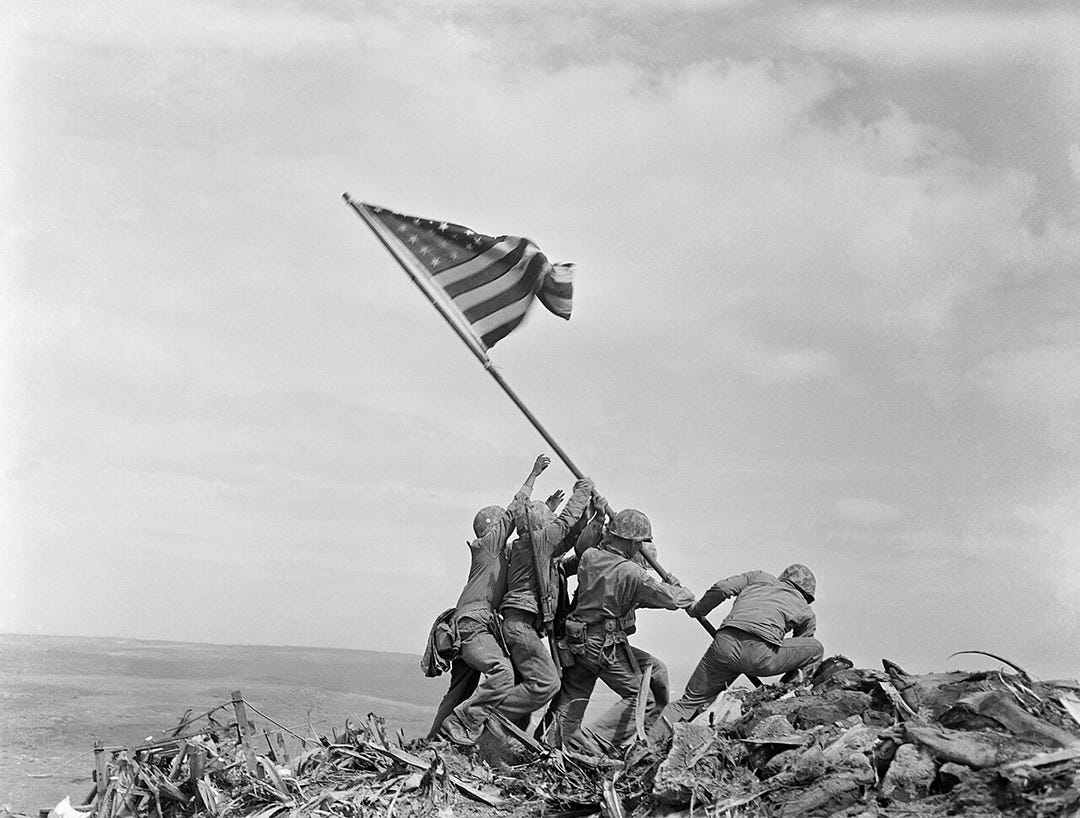
Six men, a length of Japanese water pipe, and a wind that arrives at exactly the right moment. Joe Rosenthal was thirty-three, an Associated Press photographer rejected by the Army for poor eyesight, and he very nearly missed the picture that would outlive everyone in it. He had climbed Mount Suribachi on the fifth day of the battle and was stacking stones and a sandbag to gain a few inches of height when the men began to move. He turned, raised a Speed Graphic, and fired at 1/400 of a second without properly getting his eye to the viewfinder. He did not know what he had. The film went to Guam to be developed, and the photograph had traveled around the world before its author ever saw it.
The frame records a replacement. A smaller flag had gone up on the summit roughly two hours earlier and had been photographed by Louis Lowery of Leatherneck; a larger one was carried up so it could be seen from the beaches below. The most reproduced American photograph of the Second World War is therefore not the moment of capture but the second flag of the morning, an administrative substitution that happened to be beautiful. This is the detail people reach for when they want to call the picture a lie, and it is the wrong detail, because nothing about the substitution was performed for a camera.
The accusation came from somewhere else entirely. After the raising, Rosenthal gathered Marines beneath the standing flag for a posed group shot — the “gung-ho” picture, arms up, rifles raised. Days later a correspondent asked whether he had posed his Iwo Jima photograph. Thinking of the group shot, he said yes. A Time radio program broadcast the claim that the flag raising itself had been staged. Time retracted the story and apologized. The retraction traveled a fraction as far as the charge, which Rosenthal then spent sixty years denying. It is false, and it has always been provably false: Sergeant Bill Genaust stood at Rosenthal’s shoulder filming the same seconds in color motion picture, and his footage shows the raising unfolding exactly as the still frame describes it, unposed and unrepeated. Genaust was killed on Iwo Jima nine days later. His body was never recovered.
What happened next to the picture was less careful than what happened in it. It won the Pulitzer Prize in 1945, the same year it was made. Within weeks it was conscripted into the Seventh War Loan drive and printed on billboards and posters. It became the model for Felix de Weldon’s Marine Corps War Memorial. And the Marine Corps has twice had to correct the record of who is actually in it, revising the identifications in 2016 and again in 2019 — the men now named as Harlon Block, Harold Keller, Ira Hayes, Harold Schultz, Franklin Sousley and Michael Strank. Rosenthal died in Novato, California on August 20, 2006, at 94 — twenty years ago this Thursday — still answering the same question.
WHY IT MATTERS
The most damaging thing ever said about this photograph was untrue, and it stuck anyway, because a correction is a weaker object than an accusation. That asymmetry has not improved with better technology; it has industrialized. The useful lesson is not that Rosenthal was vindicated — a Marine with a movie camera happened to be standing beside him, which is luck, not method — but that the picture survived on evidence that existed independently of its author’s word. As authorship itself becomes the thing in question, the photographs that will hold up are the ones with a second witness.
EXHIBITION HIGHLIGHTS
Monumental — Gerwyn Davies
Michael Reid, Berlin
August 17 – September 20, 2026
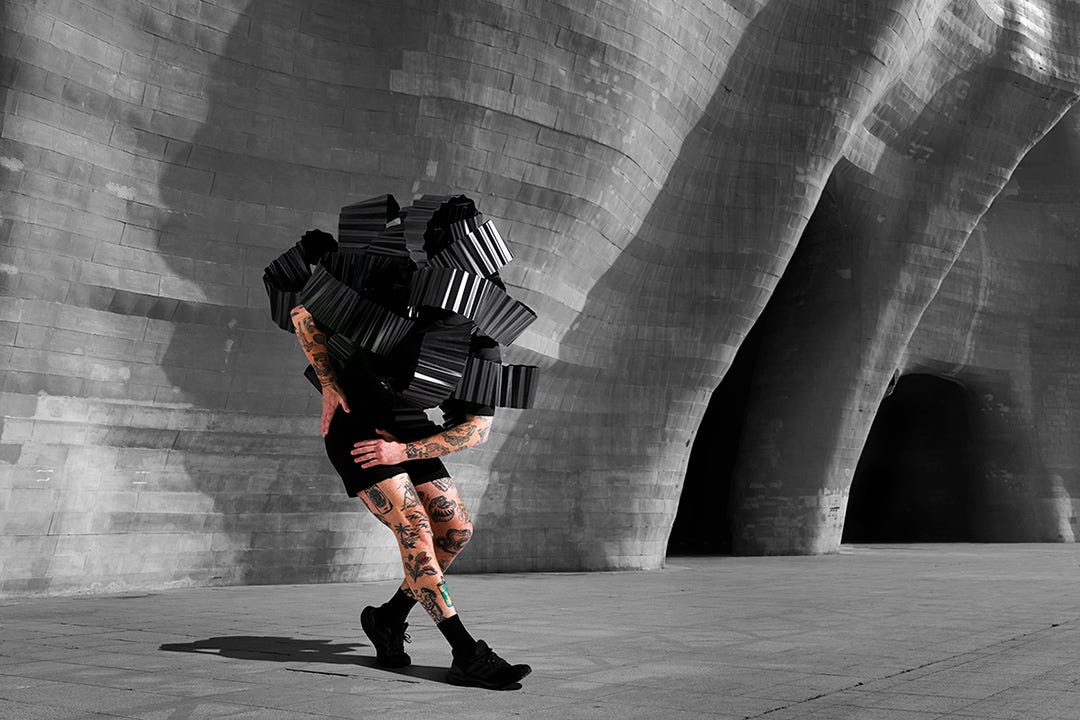
The Queensland-born, Sydney-based artist opens at Michael Reid’s Berlin gallery on the morning this issue lands, with a body of work photographed in Shanghai and timed to debut officially during Berlin Art Week. Davies builds elaborate costumes and then photographs himself inside them, a practice that has made him one of the more precise thinkers on queer visibility working in the medium — his images make the self hypervisible and hidden at once, exploring what he calls “the potential for queer subjects to wrest greater control through perversions of visibility and the dictating of terms by which they are exposed.” In Monumental the costume constructions echo the built environment in material and form, conjuring architectural image worlds where “character and context coalesce, and clear distinctions between figure and ground, subject and object, seen and unseen, are queerly collapsed.” He won the Olive Cotton Award in 2023 and is currently the subject of the survey Sunburn at Tweed Regional Gallery.
Mysterium der Paare
Kunst und Kultur Monschau, Monschau, Germany
August 9 – November 1, 2026
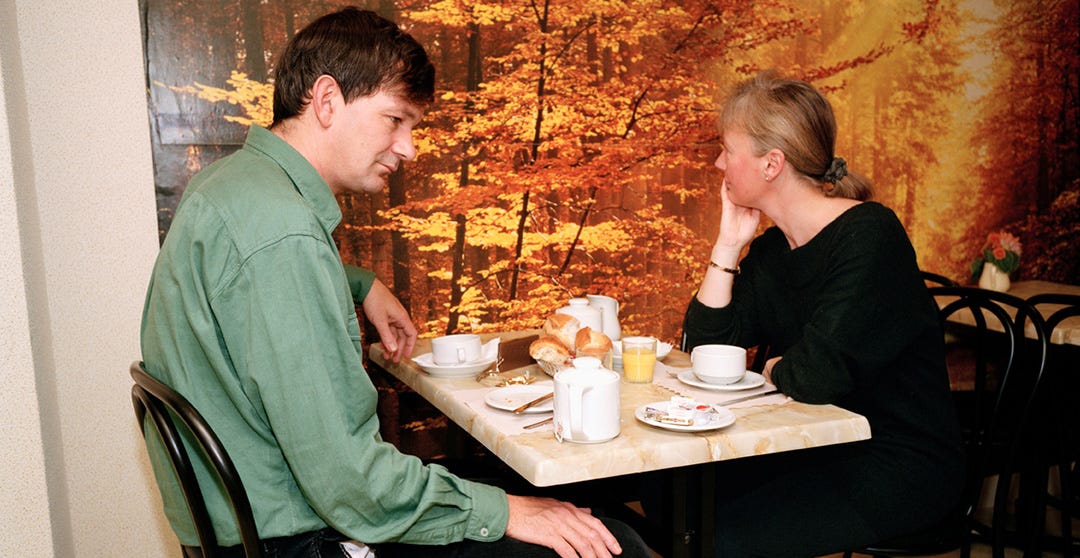
Around 130 photographs by more than fifty photographers, on the single subject of two things found in proximity — which turns out to be a far stranger premise than it sounds. The roster is a serious one: Martin Parr’s Bored Couples is here to argue that couples are not always in loving exchange, Richard Kalvar supplies the politicians caught mid-absurdity, Elliott Erwitt the New York street coincidences, alongside Inge Morath, Willy Ronis, Herbert List, Barbara Klemm, Sibylle Bergemann, Lotte Jacobi, Ruth Orkin, Bruce Davidson, Erich Salomon and Antanas Sutkus. Some pairings are famous and intentional — Dalí and Gala; Marilyn Monroe and Clark Gable on the set of The Misfits, the last film either would complete. Others exist only because the frame put them there, joined by a shared gesture, a repeated hairline, a matching coat. The show extends the conceit past people to animals and to still lifes, where objects enter into surprising relationships with one another, and takes its keynote from Erwitt: “Sometimes a glance is enough to tell a whole life.”
Leaning into Trouble
Fotogalerie Friedrichshain, Berlin
August 15 – September 26, 2026
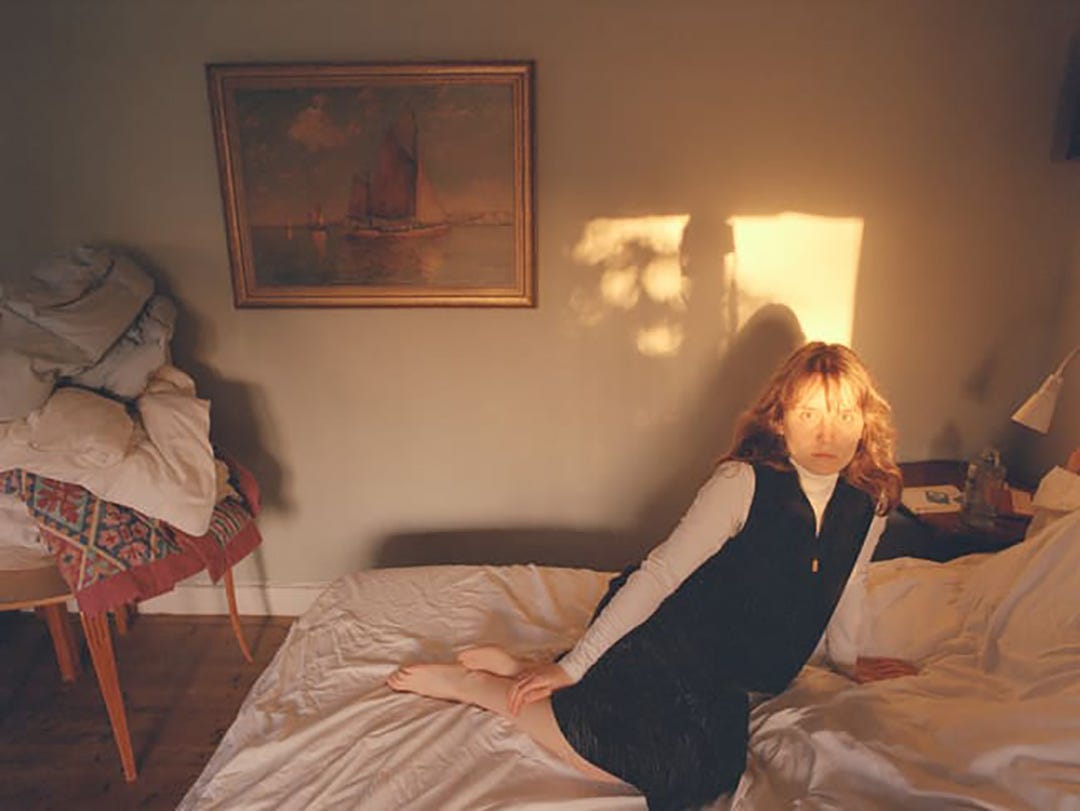
Nineteen recent positions from students in Professor Tina Bara’s Class for Photography and Moving Image at the HGB Leipzig, and a show with a clear argument about what a young photographer’s work is for. The gallery’s framing is unusually direct: we are all confronted with a restless time that pulls us into conflicts and difficulties we can neither avoid nor want to, and the nineteen respond in nineteen directions rather than one. The environment these artists move through is described as fragile, unstable and endangered, so the work is about staying in motion and practicing resistance — “regardless of whether it is angry, wild, quiet, smart, subtle, brave, funny, sad, or exaggerated.” What holds it together is an argument for photography’s banality and complexity as equally useful, a medium fit for inquiry, miscommunication and surprise. Artists include Mascha Breuer, Zina Bluhm, Esraa Dayrwan, Sally Alhindawi, Viyan Kalayci, Shary Talebian and Carla Maruscha Fellenz.
Appearance — Thomas Gust
Buchkunst, Berlin
August 8 – 29, 2026
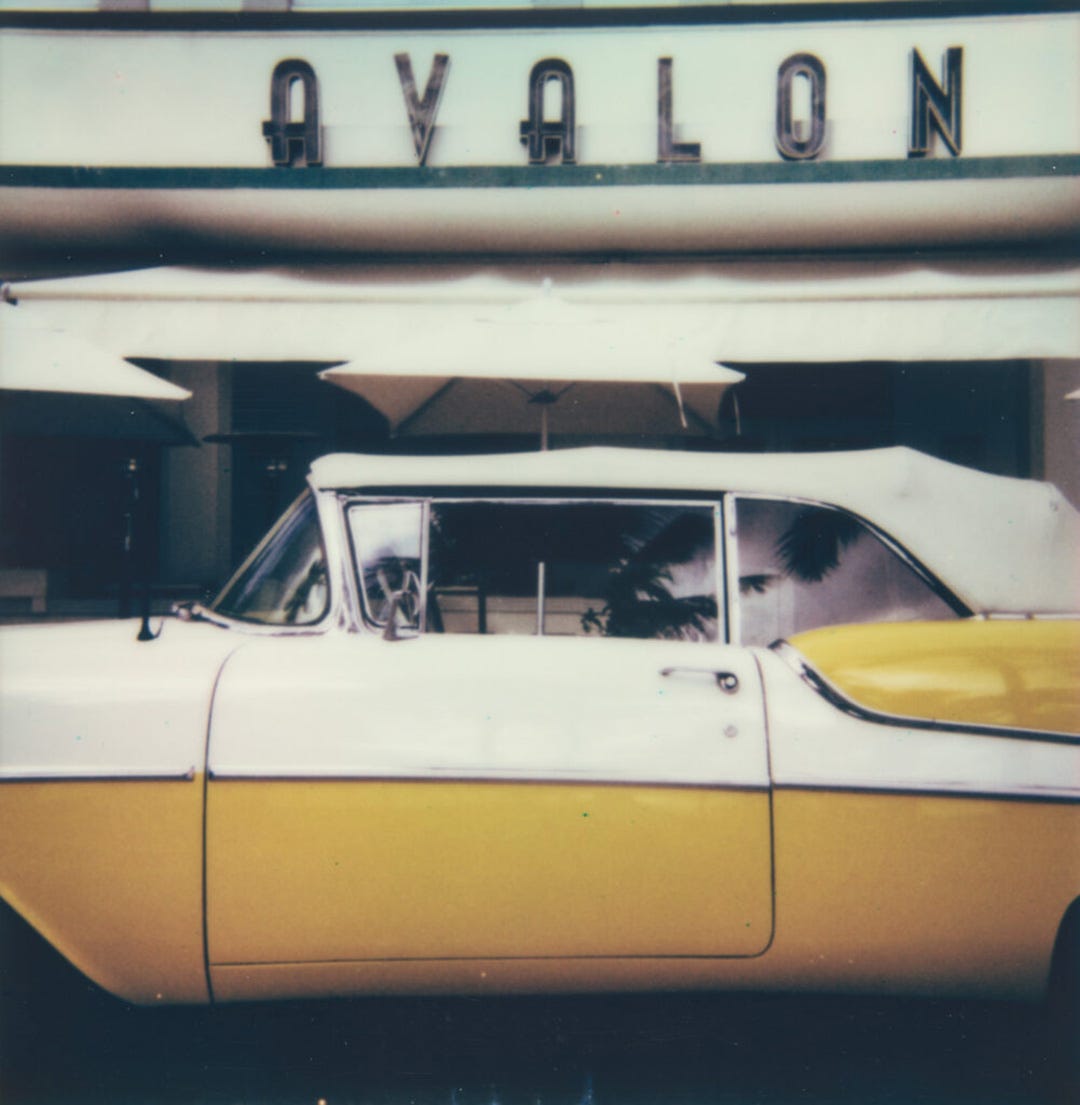
Three bodies of work shown together in Berlin for the first time, and the interest is in how differently each one damages the photographic surface. Appearance is made with a Polaroid camera and printed on Japanese Awagami paper hand-coated with albumen, so that landscapes, trees and water arrive with a fragile skin that oscillates between photograph and painting — places that refuse to behave as documents and function instead as shifting images of memory. Hong Kong Romance, made during a long stay in the city, reworks photographs of architecture and urban space with acrylic paint into new topographical image spaces; the gallery calls it a love letter to Hong Kong and an attempt to hold a city that eludes final description. The third group, Costumes, is the sharpest: it takes late nineteenth-century Japanese studio portraits of geishas — staged images produced in large editions for travelers, which did an enormous amount of work in forming the Western picture of Japan — and reinterprets them by hand. Together the three propose photography not as an immutable document but as a repository where experience, history and material keep renegotiating.
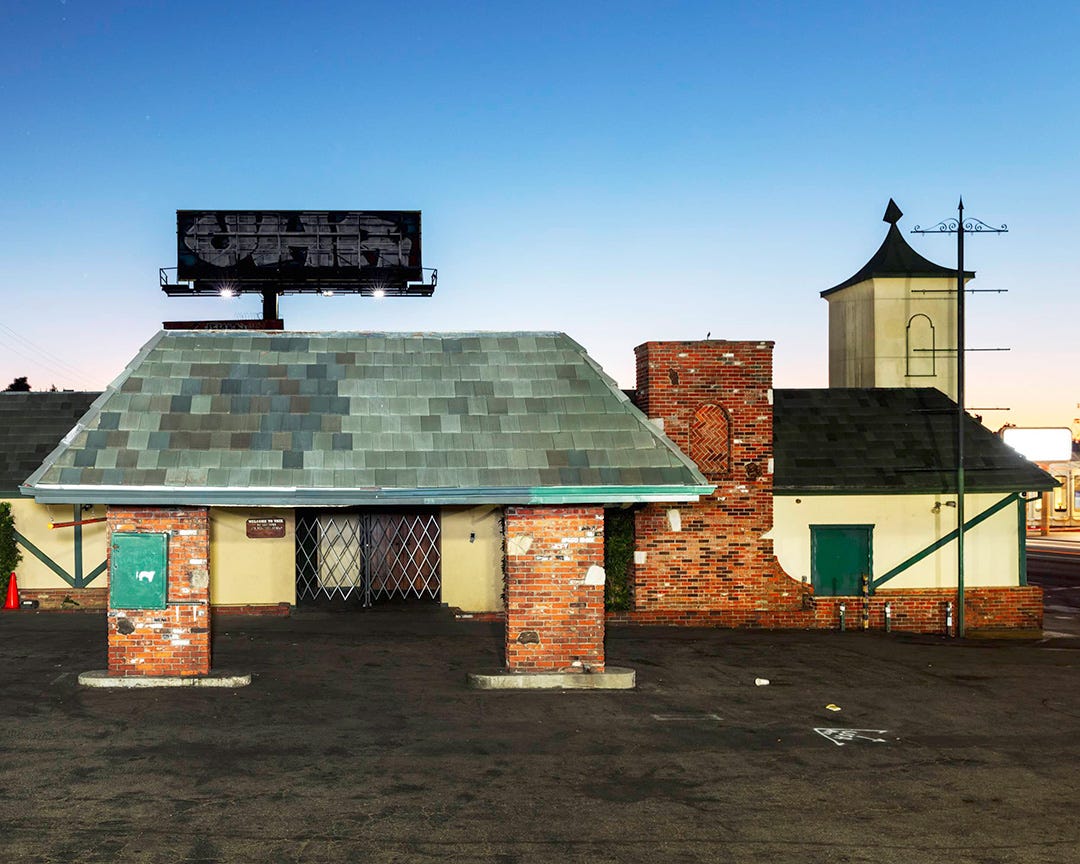
1911 Sunset Boulevard
Gallery Luisotti, Los Angeles
August 8 – September 12, 2026
Six artists on one address: the former Taix French Restaurant in Echo Park, followed through its final months, its closing night, and the vacant ground left by its demolition. The exhibition is smart about refusing the obvious job — it does not assemble a unified portrait or treat documentation as a way of restoring the building intact. Maxfield Hegedus photographs the interiors with sustained descriptive precision, pushing past the recognizable rooms into banquet halls, corridors and dressing areas where brick, murals, patterned carpet, false arches and artificial plants become newly legible as accumulated style; Abdi Taslimi works from inside the restaurant’s social life, figures and booths surfacing unevenly through darkness and grain; Evan Whale scratches into his prints and works over them in oil pastel until description is interrupted by abrasion; Kittipong contributes an image ruined twice over, multiply exposed because the film would not advance and then fogged by an X-ray at the Mexican consulate. Arturo Soto begins only after the building is gone, and Marcel Alcalá’s painting GGNAT puts two figures behind DJ equipment against the brick. Ed Ruscha’s Every Building on the Sunset Strip hangs as the long context, Gallery Luisotti notes — a reminder that in Los Angeles, disappearance is the ordinary condition rather than the interruption.
WHAT’S ON AROUND THE WORLD
Openings, closings, and the shows worth a trip.
Opening This Week
Denver
Sites of Memory — Colorado Photographic Arts Center · Opened Aug 7, through Sep 19 (inspired by the 2026 One Book One Denver selection)
Düsseldorf
Dialog und Fotografie — KIT Kunst im Tunnel · Opened Aug 8, through Aug 30 (work made with children and young people from refugee families)
Helsinki
du soleil, que ça existe — Charlotte Clermont — Hippolyte Studio · Opened Aug 7, through Sep 6 (two-channel analog projection)
New Plymouth
Economies of Deferral — Govett-Brewster Art Gallery · Opened Aug 8, through Nov 15 (Fiona Clark, Ngahuia Harrison, John Miller)
Oslo
Kate and Carol — Fotografiens Hus · Opened Aug 13, through Sep 27 (Katharine MacDaid and Cheryl Newman)
Portland, Oregon
Real But Not True — Dawn Surratt — Blue Sky Gallery · Opened Aug 6, closes Aug 29 (found and self-made photographs layered with leather, thread, paper and wood)
Tokyo
The Joy of Honeybees — Masami Sasaki — FUJIFILM SQUARE · Opened Aug 14, through Sep 10
Vienna
ich sehe was, was du nicht siehst. aber ich mach die augen zu — Photo Cluster · Opened Aug 14, through Aug 30
Zarautz
Una historia después del eclipse — Photomuseum Zarautz · Opened Aug 7, through Sep 27 (Colección Modus Vivendi; includes Thomas Ruff)
Closing Soon
Antwerp
The Heart of the Matter — Carrie Mae Weems — FOMU · Closes Aug 23
.tiff 2026 — FOMU · Closes Aug 23 (ten emerging artists working in Belgium)
Berlin
Why These? — Bruce Gilden — Fotografiska Berlin · Closes Aug 23, 18:00
Bonn
Eyes Open in the Dark — Peter Hujar — Bundeskunsthalle · Closes Aug 23
Budapest
Report on Hungary, 1948 — Robert Capa — Capa Center · Closes Aug 23
Chicago
Prix Pictet – Storm — Museum of Contemporary Photography · Closes Aug 22
The Hague
Life, Love and Death in Sicily — Letizia Battaglia — Fotomuseum Den Haag · Closes Aug 23
New York
Becoming Marilyn — Staley-Wise Gallery · Closes Aug 21
San Francisco
Too Many Products — Janet Delaney — EUQINOM Gallery · Closes Aug 22
Washington
Beneath the Surface: Mining and American Photography — National Gallery of Art · Closes Aug 23
Ongoing
A rotating selection of shows worth the trip, beyond the openings and closings above.
Amsterdam
World Press Photo Exhibition 2026 — De Nieuwe Kerk · Through Sep 27
Berlin
Corbijn, Anton — Fotografiska Berlin · Through Sep 20 (fifty years, nearly 150 works)
London
Nice Day For It! The British Summer in Technicolour — Photofusion · Through Sep 5 (Anna Fox, Daniel Meadows, Martin Parr, The Caravan Gallery; Tue–Sat)
Japanese Women Photographers: From 1950s to Now — The Photographers’ Gallery · Through Sep 27 (27 artists)
New York
Hujar:Contact — The Morgan Library & Museum · Through Oct 25 (the contact sheets and job books)
FESTIVAL WATCH
Festival La Gacilly-Baden Photo 2026 — “SO BRITISH!” — Baden bei Wien, Austria · Jun 12 – Oct 11 (free, on a seven-kilometer outdoor route; Don McCullin, Terry O’Neill, Robert Capa, Tony Ray-Jones, Anna Atkins; dedicated to the memory of Jane Goodall and Martin Parr)
Giles Duley — Artist Talk — Leica Gallery Vienna, Seilergasse 14 · Wed Aug 19, 18:30 (free, registration required; presented with the La Gacilly-Baden festival)
Stirling Photography Festival 2026 — “Journey” — Stirling, Scotland · free throughout (RPS Touring Documentary Awards opens Aug 21 at The Smith Art Gallery; Fabrizio Gianni’s Fab! opens Aug 22 at the Macrobert Arthouse; Michael Cook and Callum McKenzie open Aug 22 in Dunblane)
Organ Vida 14 — “Happy Spiraling” — Zagreb, Croatia · Jun 11 – Sep 6 (Museum of Contemporary Art and SKD Prosvjeta Gallery; Julie Béna, Kevin Osepa, Hertta Kiiski)
PhEST 2026, XI edition — “What if?” — Monopoli, Puglia · Aug 8 – Nov 1 (closed Mondays; Vivian Maier, Roger Ballen, Joan Fontcuberta, Juno Calypso, Nick Brandt, Deanna Dikeman)
Gibellina Photoroad, VI edition — Gibellina, Sicily · Jul 4 – Sep 6 (special edition for Gibellina’s year as Italian Capital of Contemporary Art; Erik Kessels, Teresa Giannico, Stefano Cerio, Alice Grassi, Jacopo Di Cera)
Visa pour l’Image 2026, 38th edition — Perpignan · Aug 29 – Sep 13 (opens a week Saturday; Pro Week Aug 31 – Sep 5)
Unseen has moved — the fair is no longer a September event in Amsterdam; the next edition runs Mar 18–21, 2027 at Rotterdam Ahoy, folded into Art Rotterdam
OFF THE PRESS


Futures Past by Spencer Lowell
Lowell has spent a career photographing the places where scientific ambition becomes physical plant — power stations, laboratory experiments, computational imagery, the infrastructure that most people are asked to trust without ever seeing. Futures Past gathers more than fifty photographs made between 2007 and 2024, a stretch the publisher fairly describes as a period of rapid technological acceleration worldwide, and the editing decision is the interesting one: the pictures are presented without hierarchy or chronology, so that two decades arrive simultaneously rather than as a story with a direction. The argument underneath is that technology is not a departure from the natural world but one of its emergent forms, and that within that continuum human agency is still present but diffuse, distributed across systems growing larger, faster and less legible. Edited by Alyssa Coppelman with a text by Daniel Sherrell, and bound so it opens flat under a cover image of crumpled tin foil, from Kris Graves Projects.
Ihr denkt, wir waren anders by Petra Göllnitz
The premise is a straight comparison, and it is unusually disciplined about it: photographs made in East and West Germany between 1945 and 1989, drawn from around two hundred of the period’s significant photographers, and hung so that each image from one side meets a counterpart from the other. What emerges from the pairing is not the expected catalog of difference but a persistent, awkward similarity — childhood and youth, work and domestic life, protest, politics, fashion, the ordinary business of a week. The sequence moves through the hardship of the immediate postwar years, the hopeful stretch of reconstruction, and the reawakening energy of both societies, and it is candid about what the division cost on each side of the wall, including the forms of freedom that existed only on the other one. Essays by Annett Gröschner, Hans-Hermann Klare and Christoph Tannert, published to accompany the exhibition by Kehrer Verlag.
Hear the World by Bryan Adams
Steidl, co-published with the Hear the World Foundation, Steinhausen
Adams has now been photographing for the Hear the World Foundation since 2007, and this is the first time the resulting archive has been gathered in one place — more than 120 portraits of the foundation’s ambassadors, drawn from film, theater, music and fashion, among them Julianne Moore, Bruce Springsteen, The Weeknd, Priyanka Chopra, Jared Leto, Léa Seydoux and Lenny Kravitz. The organizing device is a simple one and it holds the book together: each sitter strikes their own version of the Hear the World pose, a hand cupped to the ear, so that a portrait commission becomes a repeated gesture performed a hundred and twenty different ways. The foundation supports children with hearing loss in low- and middle-income countries, on the principle that every child deserves the chance to hear well, and the project’s long duration is what gives the pictures their interest — a nineteen-year run of studio sessions accumulating into an argument about a sense most people never think about until it goes.
OPEN CALLS
2026 Paris Photo–Aperture PhotoBook Awards — Aperture with Paris Photo · Deadline September 4, 5pm EDT (books must arrive by then) · $30 First PhotoBook, $60 PhotoBook of the Year and Catalog · $10,000 to the First PhotoBook winner, with all shortlisted books exhibited at Paris Photo. The early-bird rate has closed.
Open Call for Solo Artists 2027: “Free Hands” — Copenhagen Photo Festival · Deadline September 1 · International; a minimum of 10 images and a 3,000-character concept in English or Danish. Selected artists receive a solo exhibition across Copenhagen and southern Sweden with a €537 artist fee, €400 travel support, €134 per diem, full production and PR.
Xposure International Photography Awards 2026/27 — Xposure Festival, Sharjah · Deadline September 5, extended entry to September 20 · Free · $6,000 to the overall winner plus flights and accommodation to the Sharjah awards ceremony and a festival exhibition. Film submissions have already closed.
Brave New Visions: Creativity as Rebellion — PhotoVogue / Condé Nast · Deadline September 11, 5:59pm · Free · $12,000 in grants split across three artists.
PhMuseum 2026 Women Photographers Grant — PhMuseum · Opens September 8; €25 until September 19, €30 until October 10 · The tenth edition. $11,000 in cash prizes, a solo show at PhMuseum Lab, a €5,000 MPB voucher, a Vogue Italia interview and a PhotoVogue Festival 2027 screening.
2026 Lucie Scholarship Program — Lucie Foundation · Deadline September 30 · $25 professional, $15 emerging · Four grants — $3,000 and $1,000 in each of Fine Art and Photojournalism/Documentary — plus Sony equipment and a group show touring the House of Lucie galleries.
James Balog Earth Vision Awards — Denver Art Museum · Opens September 1, closes October 1 · Free · A new biennial award endowed by Balog: $40,000 to the winner, whose work enters the museum’s permanent collection.
ON THIS DAY
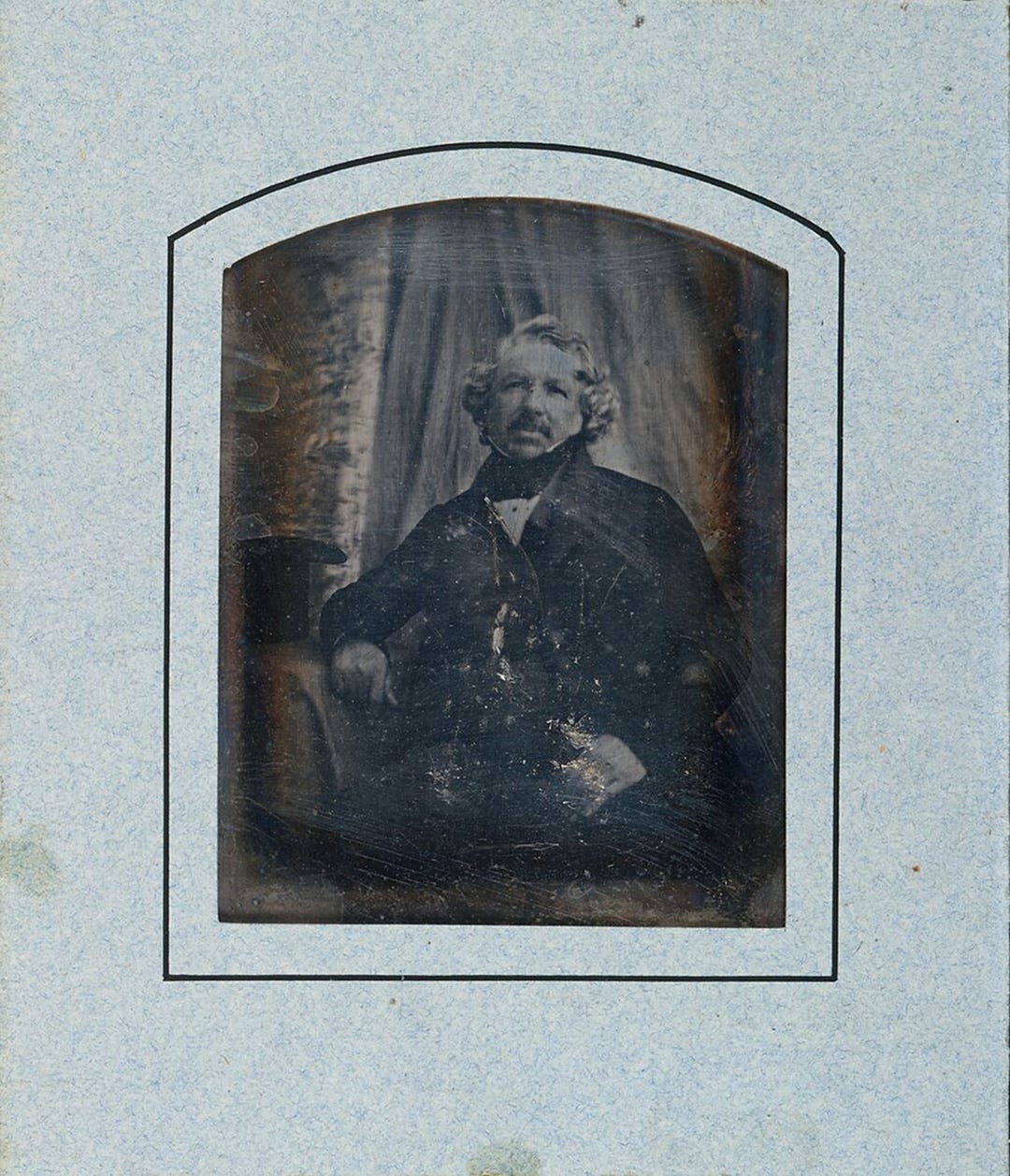
August 19, 1839 — The daguerreotype was given away. At a joint session of the Académie des Sciences and the Académie des Beaux-Arts at the Institut de France, with the overflow crowd spilling into the courtyard outside, François Arago explained the process step by step: the silvered copper plate, the iodine vapor, the exposure, the mercury fuming that raised the latent image, the salt bath that fixed it. What made the session extraordinary was not the chemistry but the arrangement behind it. Rather than let Louis Daguerre license the invention, the French state had bought it outright and settled lifetime pensions on Daguerre and on Isidore Niépce, the son of Daguerre’s late collaborator Nicéphore, expressly so that the process could be released without patent — free, in the government’s framing, to the world. Within weeks opticians in Paris could not make cameras fast enough. There was one pointed exception, and it says a great deal about how the nineteenth century actually worked: five days before the announcement, an agent acting for Daguerre had secured an English patent, so the one country where the free gift did not apply was Britain, where practitioners had to pay for a license for years afterward. The anniversary is now marked as World Photography Day, and The Met keeps the fullest account of what was handed over.

THE INTERNATIONAL REVIEW OF PHOTOGRAPHY
To advertise an exhibition, book, fair, or open call to photography collectors, curators, and gallerists worldwide, email internationalphotographynews@gmail.com