THE FRAME
Lee Miller Finally Gets the French Retrospective She Deserved
The Musée d’Art Moderne de Paris opened its Lee Miller retrospective on April 10 — the largest devoted to her in France in twenty years, and the most comprehensive to date. Initiated by Tate Britain in collaboration with the Art Institute of Chicago, the exhibition brings together approximately 250 vintage and modern prints, some of which have never been exhibited, and follows her entire career across six sections combining chronological and thematic approaches.
The arc of Miller’s life reads like a novel someone made up: a Vogue model turned Surrealist artist, portraitist, and fashion photographer who then became a U.S. Army-accredited war correspondent, photographed the liberation of Dachau and Buchenwald, and famously bathed in Hitler’s Munich bathtub the day he died — a photograph taken by David E. Scherman of LIFE magazine. Her post-war years were quieter: she mostly stopped shooting, struggled with PTSD and depression, and didn’t show her children the boxes of war photographs stacked in the attic until the 1970s.
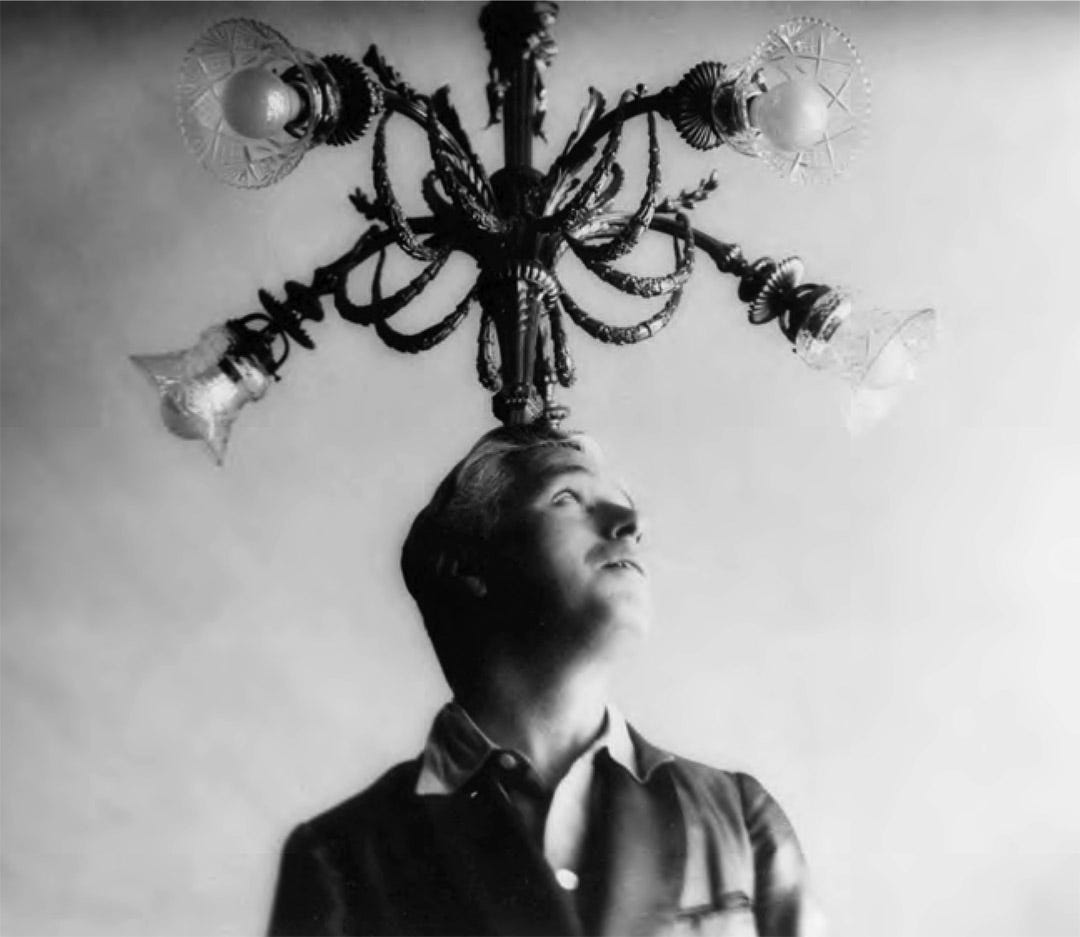
For decades she was remembered primarily as Man Ray’s muse and collaborator. The solarization technique she co-developed with him — accidentally discovered in 1929 when a cat ran into the darkroom and the lights came on — was often attributed to him alone. The rehabilitation of her reputation as a photographer in her own right has taken most of the last thirty years. This exhibition, running through August 2, 2026, is part of that ongoing reclamation.
WHY IT MATTERS
Miller’s career is a case study in how history chooses who to remember — and who to relegate to the footnotes. She was one of the first photographers to document the Holocaust from inside the camps as a witness, not a journalist at a distance. Her images from Dachau remain among the most disturbing and morally necessary photographs ever made. The fact that it took until 2026 for France to give her this kind of retrospective is itself part of the story. If you’re anywhere near Paris before August, this is not optional.
ON VIEW
New This Week
Lee Miller
Musée d’Art Moderne de Paris
Apr 10 – Aug 2, 2026
250 prints across six sections. See THE FRAME above.
Martin Parr: A Tribute
Foam, Amsterdam
Spring 2026
In commemoration of his passing last December, Foam presents a tribute to Parr’s legacy: a selection from his extensive oeuvre including his celebrated self-portraits taken in local studios worldwide and a survey of his photobook work. Made in collaboration with Magnum Photos and the Martin Parr Foundation.
FAKE!
Rijksmuseum, Amsterdam
Through May 25, 2026
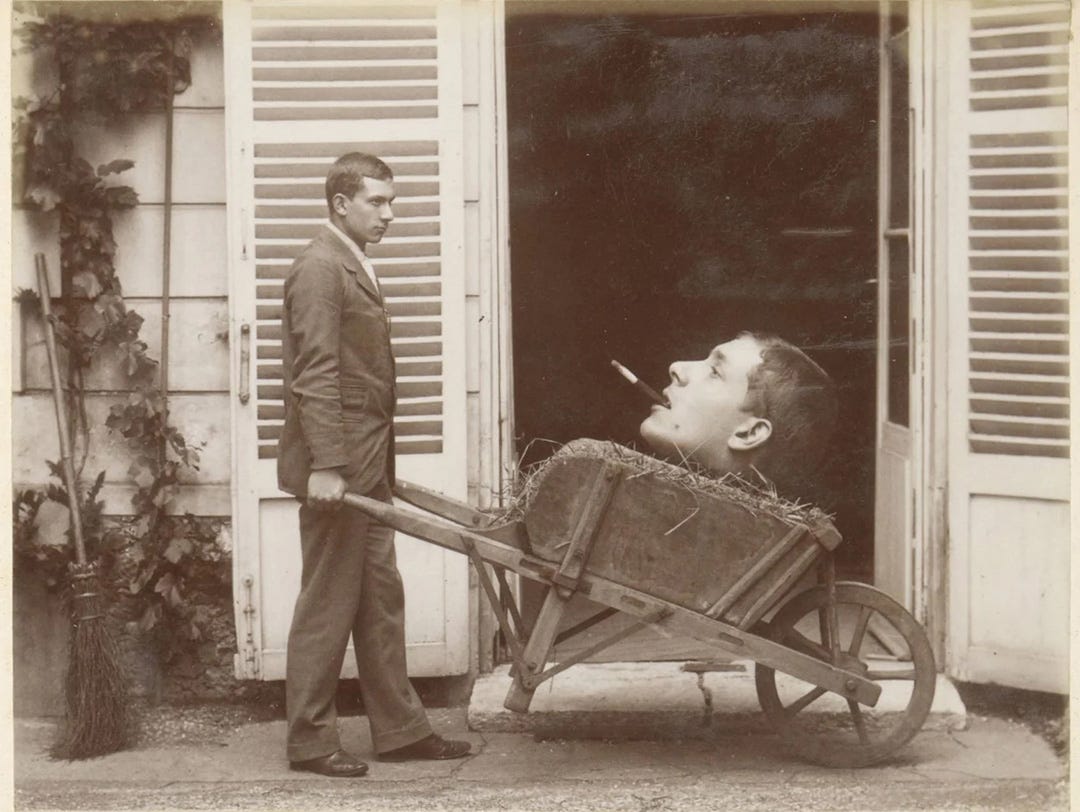
Fifty historical images revealing how photographers have manipulated pictures since 1860 — cutting, pasting, drawing, and re-photographing before Photoshop existed. Works by John Heartfield, Martin Post Card Company, and others. A reminder that the debate over image manipulation didn’t begin with AI.
Always Running: Photography by Luis J. Rodriguez
Vincent Price Art Museum, Monterey Park
Apr 14 – Jun 13, 2026
Rare and unpublished photographs by Chicano poet and community leader Luis J. Rodriguez, marking the 30th anniversary of his memoir Always Running: La Vida Loca, Gang Days in LA. Portraits of the people and neighborhoods that shaped his early life in East Los Angeles and the San Gabriel Valley.
CLOSING SOON
Apr 16: Sotheby’s Photographs Part II closes online.
Apr 25: Binh Danh & Renee Royale — ROSEGALLERY, Santa Monica.
Apr 25: JR: Horizons — Perrotin, Los Angeles.
May 4: Sony World Photography Awards Exhibition — Somerset House, London.
May 16: Outside Help — Christopher Richmond, Moskowitz Bayse, Los Angeles.
May 24: Sophie Calle: Overshare — OCMA, Costa Mesa.
May 25: FAKE! — Rijksmuseum, Amsterdam.
THE PHOTOGRAPH
Immediate Family — Sally Mann, 1984–1994
Through the 1980s and into the early 1990s, Sally Mann photographed her three children — Emmett, Jessie, and Virginia — at their family farm in Lexington, Virginia. She used an 8×10 view camera, the cumbersome equipment of an earlier era, and made images that were technically exquisite and emotionally raw: children sleeping, swimming, bleeding, playing, staring, dreaming. The photographs were made during the summers, which at the Mann farm were long and unsupervised and occasionally dangerous in the way summers should be.
When Aperture published Immediate Family in 1992, it sold out immediately and ignited a controversy that reached Congress. The FBI investigated. Libraries removed the book. Mann was accused of exploiting her own children, of creating child pornography, of irresponsibility toward the very subjects she most loved. The children — who were part of the process, who often suggested the images — were not consulted by the critics. Emmett, Jessie, and Virginia grew up to be artists themselves. None of them has expressed regret.
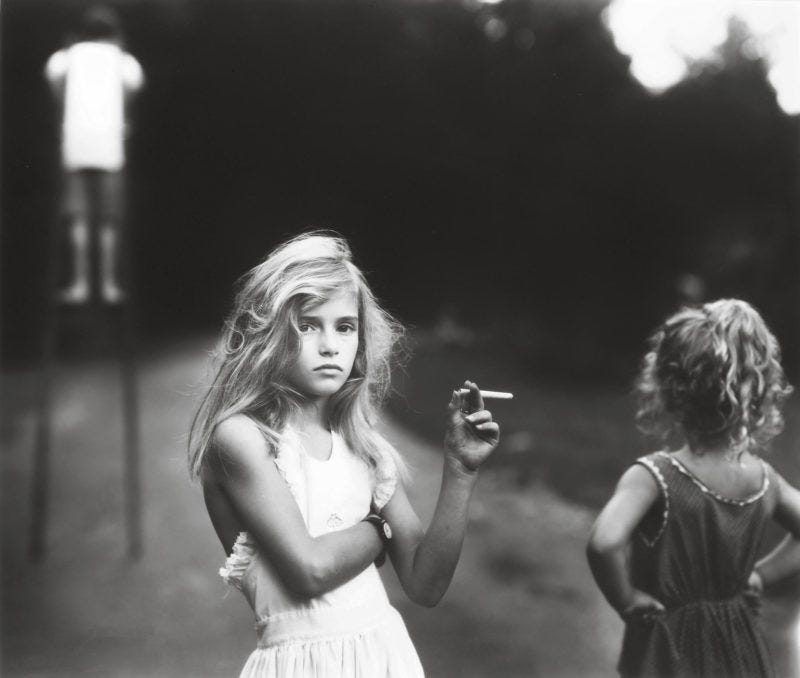
Mann was 36 when the project began. “The borders of our selves were not clearly fixed,” she wrote later. “We overlapped.” The images are in the collections of the Metropolitan Museum of Art, the Smithsonian American Art Museum, the Whitney, and dozens of institutions worldwide. Immediate Family is now regularly cited as one of the most important photography books of the 20th century — and one of the most debated.
WHY IT MATTERS
The controversy around Immediate Family forced a reckoning with questions photography still hasn’t finished answering: Who owns a child’s image? Can a parent be both witness and author when photographing their own family? Where does intimacy end and exposure begin? Those questions feel more urgent now than they did in 1992, in an era when millions of parents photograph their children daily and post them online without a second thought. Mann did it with a large-format camera, on film, for art. We are all doing it now, for Instagram.
IN THE NEWS
This Week
World Press Photo 2026 Contest Winners Announced
The 2026 World Press Photo Contest winners were announced on April 10, selected from 57,376 photographs submitted by 3,747 photographers across 141 countries. The awarded works span conflict and crisis, resilience, resistance, and cultural traditions. Jury chair Kira Pollack: “This is a critical moment — for democracy, for truth, for the question of what we as a society are willing to see and call out and what we are willing to ignore. The photographers recognized here have done their part. They have made the record.” The World Press Photo of the Year will be announced April 23. World Press Photo
Unique Photographs Are Rewriting the Rules of the Photo Market
A new Artnet analysis finds that collectors are increasingly seeking photographs that cannot be reproduced — photograms, hand-painted prints, camera-less works. Artnet’s Spring Photographs Sale, live for bidding through April 16, features one-of-a-kind works by Peter Beard, Adam Fuss, Andy Warhol, Eggleston, and Cartier-Bresson. The shift is driven by a new generation of collectors seeking rarity and “wall power” — bringing the photography market closer to painting. Read the full analysis
THE AUCTION BLOCK
Results: Phillips New York, April 11
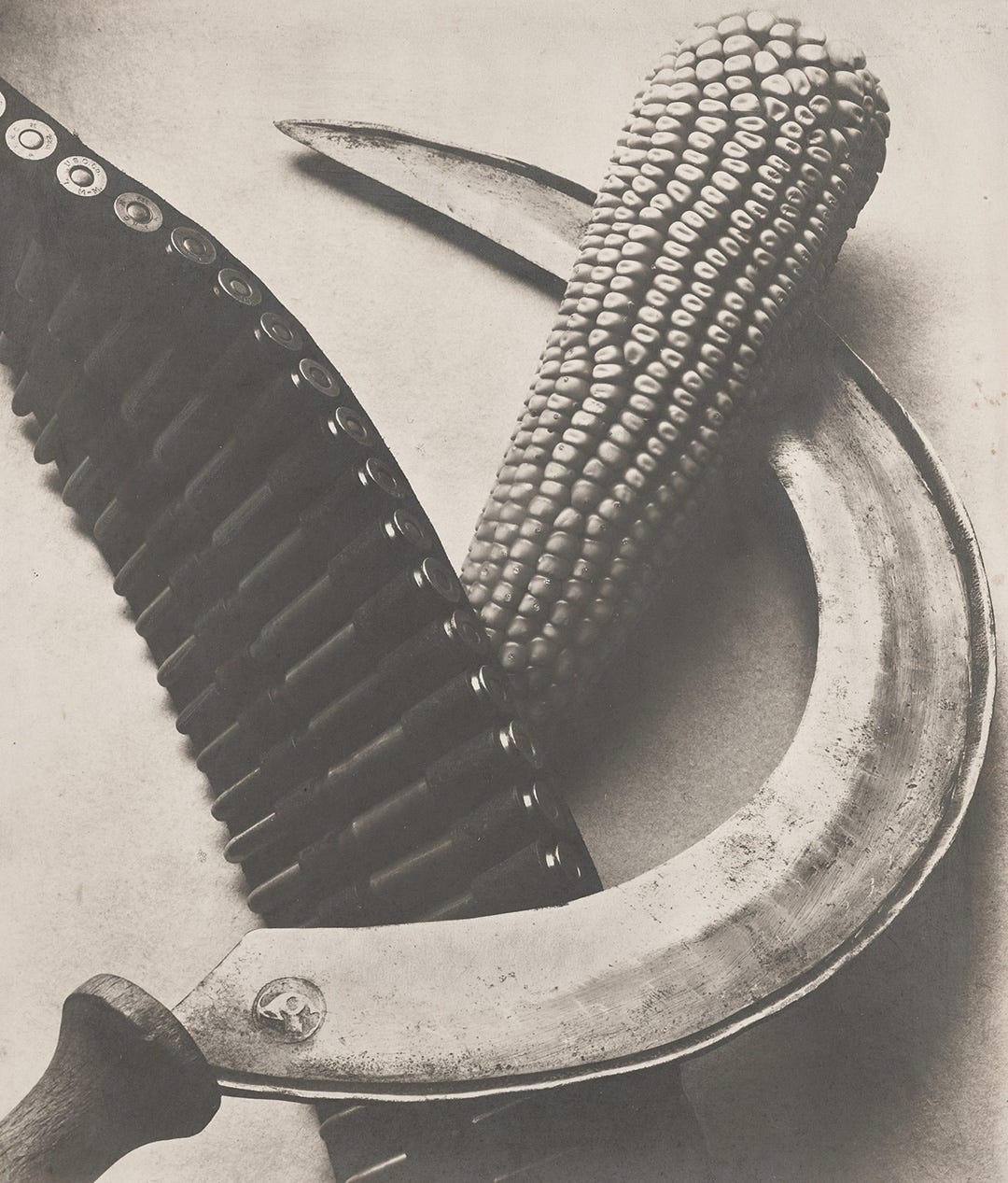
The spring’s most anticipated photography auction delivered a genuine surprise. Tina Modotti’s Bandolier, Corn, Sickle (1927) — a spare, formally perfect composition of a rifle strap, an ear of corn, and a sickle, among the most recognized images in the history of the medium — sold for $645,000, more than four times its high estimate of $150,000. It was the clear top lot of the sale and one of the most significant results for a photograph at auction this spring.
Other notable results above estimate:
Sally Mann, Vinland — $41,280 (est. $20,000–30,000)
Thomas Ruff, phg.11 — $47,730 (est. $25,000–35,000)
František Drtikol, Nude — $20,670 (est. $10,000–15,000)
Jenny Holzer, AND HATE — $12,255 (est. $7,000–9,000)
Results for the anticipated top lots — Wolfgang Tillmans’s Freischwimmer 123 (est. $150,000–250,000), Cindy Sherman’s Untitled Film Still #49 (est. $120,000–180,000), and the Richard Avedon The Family (est. $150,000–250,000) — are confirmed sold. We’ll have the full breakdown, total sale figure, and market analysis in next week’s issue. Phillips results
FAIR & FESTIVAL WATCH
Opening This Week and Coming Up
Sony World Photography Awards Exhibition — London
April 17 – May 4, 2026 · Somerset House
Winners announced at the April 16 ceremony open in exhibition the following day. Over 300 images including all national award winners and the Open Competition category winners. Free to visit.
KYOTOGRAPHIE — Kyoto, Japan
April 18 – May 17, 2026
Theme: Edge. Daido Moriyama, Anton Corbijn, Pieter Hugo, Ernest Cole. Set across Kyoto’s temples and machiya townhouses.
AIPAD: The Photography Show — New York
April 22–26, 2026 · Park Avenue Armory
45th edition. New “Focal Point” single-artist sector. Aperture Portfolio Prize awarded during the fair. The most important photography market event of the spring in North America.
OFF THE PRESS
New & Noteworthy
A Color Legacy by Fred Herzog
November 2025 · 144 pages, 100 photographs
Hatje Cantz
In the 1950s and 1960s, when serious photographers shot in black and white, Fred Herzog was shooting Kodachrome in the streets of Vancouver. The results — warm reds and oranges, precise observations of people in motion, neon signs and storefronts bathed in saturated color — look nothing like documentary photography of the era. They look like now. Herzog photographed Vancouver from 1953 until his death in 2019, and also traveled to the United States, Barbados, Curaçao, Guatemala, and Mexico. Selected by the Special Trustee of his estate in conjunction with Equinox Gallery. A direct predecessor to Eggleston’s color revolution.
Glacial Optics by Tristan Duke
180 pages, 90 images
Radius Books
In 2022, Duke sailed to Svalbard — the fastest-warming place on the planet — and made photographs using camera lenses he had carved from Arctic ice. The photographs made with those lenses are unlike anything else: dreamlike, distorted, refracted through water that is disappearing. The ice itself becomes both instrument and subject. Foreword by Michael Govan, Director of LACMA, which opens its monumental new building this week. Texts by Lucy Lippard, Mark Cheetham, and William L. Fox. Duke’s work has been exhibited at the Getty, MIT Media Lab, LACMA, and C|O Berlin.
Summertime by Mark Steinmetz
Remastered Edition · 100 pages, 76 duotone plates
Nazraeli Press
Portraits of children and teenagers in distinctly American settings, made between 1984 and 1991 — when kids still rode bikes without helmets and roamed their neighborhoods without digital interruptions. This remastered edition adds 30 previously unpublished images and is printed in duotone on natural art paper, limited to 2,000 copies. A Guggenheim Fellow, Steinmetz’s work is held at MoMA, the Met, the Whitney, the Art Institute of Chicago, and LACMA. Time: “Summertime is what we yearn for most.”


OPEN CALLS
Deadlines This Month
Inge Morath Award 2026 — Deadline April 30. No fee. $7,500 from the Magnum Foundation for women and nonbinary photographers under 30.
IN THE WEEKS AHEAD
Key Dates: Through April 30
Apr 14: Always Running: Photography by Luis J. Rodriguez opens, Vincent Price Art Museum, Monterey Park, California.
Apr 16: Sony World Photography Awards ceremony, London. Winners announced.
Apr 16: Artnet Spring Photographs Sale closes.
Apr 16: Sotheby’s Photographs Part II closes.
Apr 17: Sony World Photography Awards Exhibition opens, Somerset House, London (through May 4).
Apr 18: KYOTOGRAPHIE opens, Kyoto (through May 17).
Apr 19: LACMA David Geffen Galleries grand opening, Los Angeles.
Apr 22–26: AIPAD: The Photography Show, Park Avenue Armory, New York.
Apr 23: World Press Photo of the Year announced (11:00am CEST).
Apr 30: Deadline — Inge Morath Award. Fotografia Europea opens, Reggio Emilia.
ONE QUESTION
World Press Photo selected its 2026 winners from 57,376 entries. With AI-generated images now indistinguishable from documentary photography, should photojournalism competitions require technical proof that no AI was used — or does that miss the point entirely?
Tell us what you think in the comments. We’ll highlight the best responses next issue.
DID YOU KNOW?
Photographs have been manipulated since 1860 — long before Photoshop, long before AI. The Rijksmuseum’s FAKE! exhibition (through May 25) reveals that early photographers used scissors, glue, and ink to create photomontages and collages that appeared entirely real. One of the most famous examples: a widely circulated portrait of Abraham Lincoln was actually the head of Lincoln placed on the body of John C. Calhoun, a Southern politician. It was created decades before anyone thought to question it. As the Smithsonian puts it: “We’ve been manipulating images since the invention of photography.”
ON THIS DAY
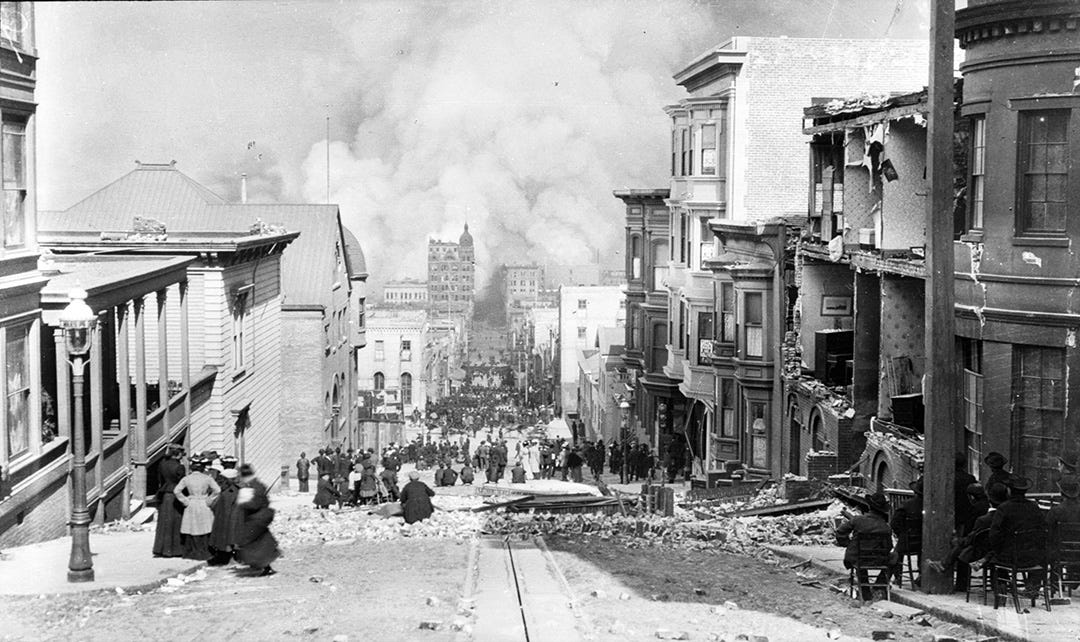
April 18, 1906: The San Francisco earthquake struck at 5:12am. Arnold Genthe’s studio and all his professional equipment were destroyed in the disaster. He made his way to a camera shop owned by George Kahn, borrowed a small 3A Kodak Special hand camera, filled his pockets with film, and spent the next several hours and days walking the burning city. He made over 180 images, including the iconic Looking Down Sacramento Street — a wide view of dazed residents standing in the rubble with smoke rising in the distance. In his autobiography, As I Remember (1936), Genthe wrote that it was one of the few times he worked entirely on instinct: the intensity of the scene meant he was “photographing without thinking about technique.” His work is now recognized as one of the founding examples of real-time photojournalism — a photographer responding to catastrophe as it happened, without a studio, without his equipment, and without a plan.