

THE PHOTOGRAPH
“Painter on the Eiffel Tower” — Marc Riboud, 1953
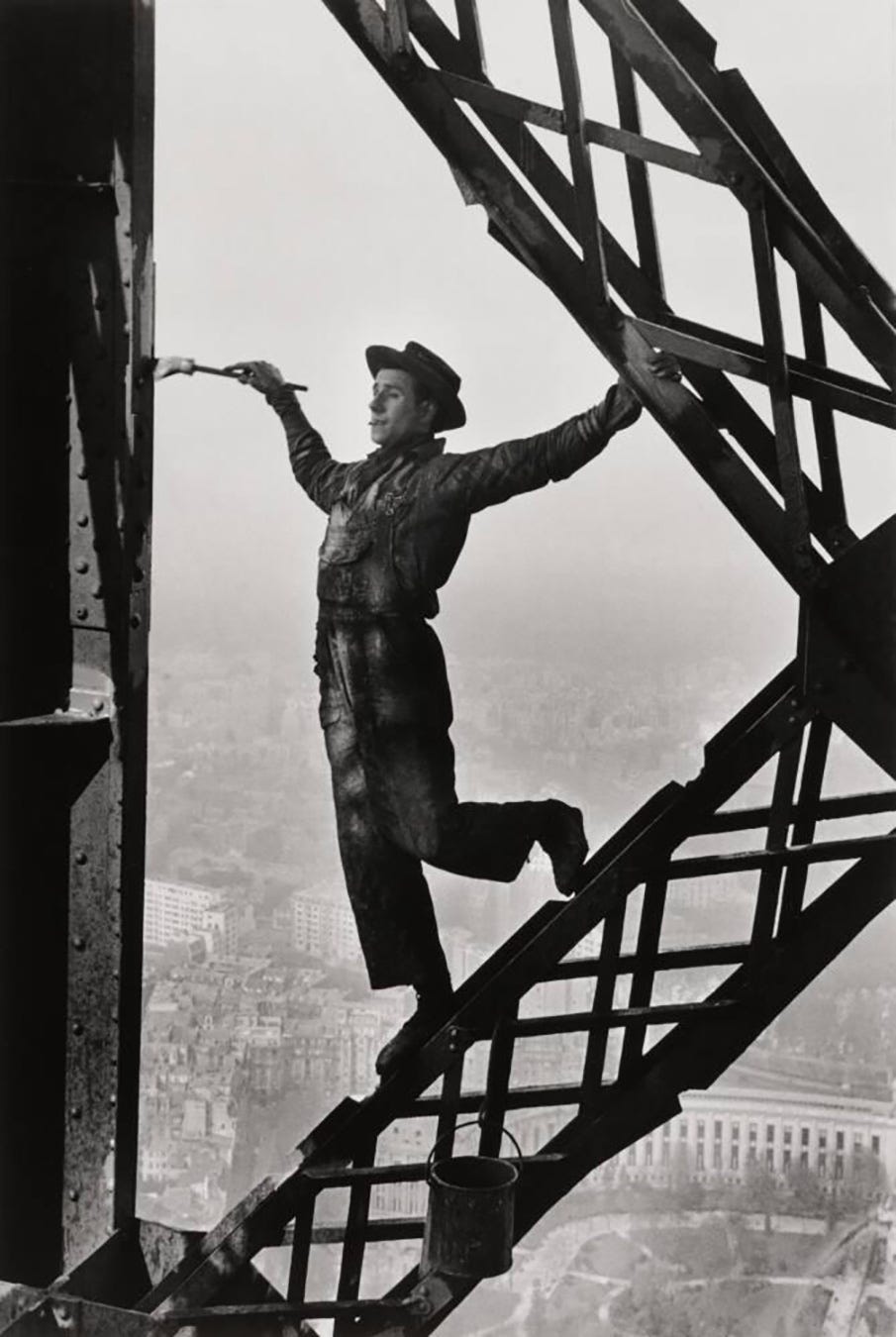
Marc Riboud died ten years ago yesterday, at ninety-three, having spent six decades photographing the Chinese Cultural Revolution, the fall of Algiers, the Watergate hearings, and the return of the Ayatollah Khomeini. He is remembered instead for a man with a paintbrush.
In 1953 the Eiffel Tower was being repainted, as it is every seven years, and Riboud — twenty-nine, recently arrived in Paris from Lyon, with an engineering degree from the École centrale and a factory job behind him — climbed up to photograph the crew. What he came back with was one painter alone on a girder, cap tilted, one hand on the ironwork and one hand working the brush, the city dissolving into haze several hundred feet below him. The man is neither posing nor working especially hard. He is loitering at altitude, and he looks like he is enjoying it.
The picture ran in Life that year. It was the first photograph Riboud ever published, and it was enough: Henri Cartier-Bresson and Robert Capa saw it and brought him into Magnum, which had been founded only six years earlier. Capa then sent him to England for a year on the theory that a French photographer should learn to work in a language he did not speak. Everything after — Yugoslavia in 1953, the overland crossing through Turkey and India to China in 1955, Ho Chi Minh, Mao at a Beijing banquet, the girl with the chrysanthemum facing the bayonets at the Pentagon in 1967 — proceeds from a man on a girder.
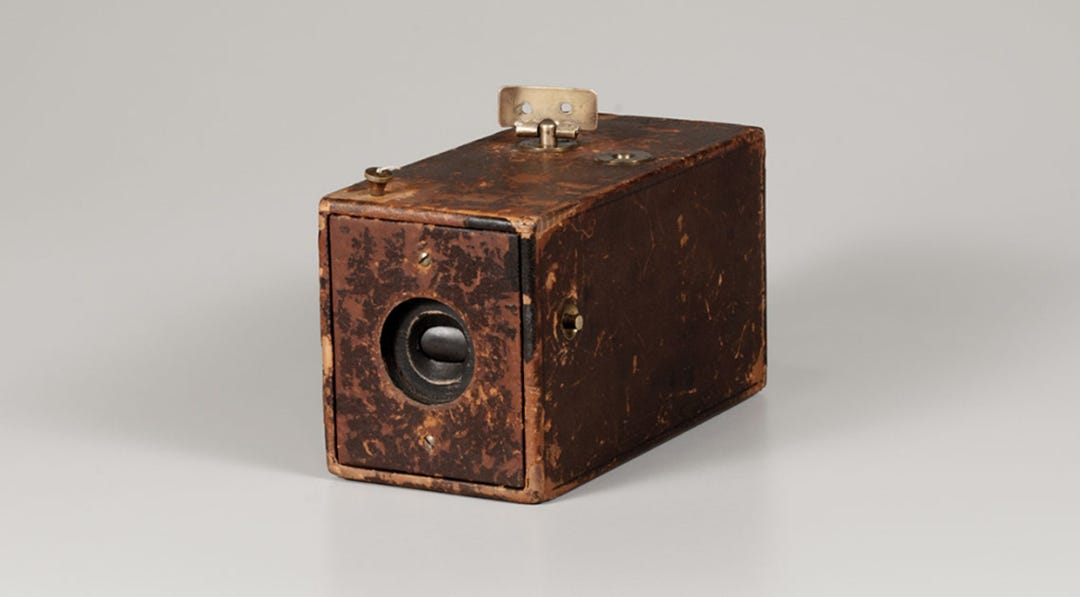
There is a detail in Riboud’s own chronology that this week makes hard to ignore. He took his first photographs in 1937, at the Paris World’s Fair, on a Vest Pocket Kodak his father had carried in the trenches of the First World War and then handed to his son. The camera that made Riboud a photographer was a Kodak — a descendant of the machine George Eastman patented on September 4, 1888, the anniversary that falls this Friday and closes this issue. Eastman’s device was built for people with no intention of becoming photographers. It made one anyway.
The print is at the Museum of Fine Arts, Houston — a gelatin silver print, bought from Etherton Gallery in Tucson in 1999 with funds from the Mundy Companies. Riboud inscribed the back in pencil: Painter on Eiffel / Paris 1953, and signed it. In 2011 he gave 192 prints from the 1950s and 1960s to the Centre Pompidou; the bulk of his archive went to the Musée Guimet in 2019, three years after his death.
WHY IT MATTERS
A career in photography is usually described as a body of work, but it very often turns on a single frame that happened to be seen by the right two people. Riboud spent sixty years earning the reputation this picture bought him in an afternoon, and he never seemed to resent it. The photograph is also, quietly, an argument about what the medium is for: not the summit, not the view, not the monument — the man hired to keep it painted, caught in the ten seconds he took for himself.
EXHIBITION HIGHLIGHTS
Jamel Shabazz: New York Vibes
Deutsche Börse Photography Foundation | The Cube, Eschborn
September 3, 2026 – January 17, 2027
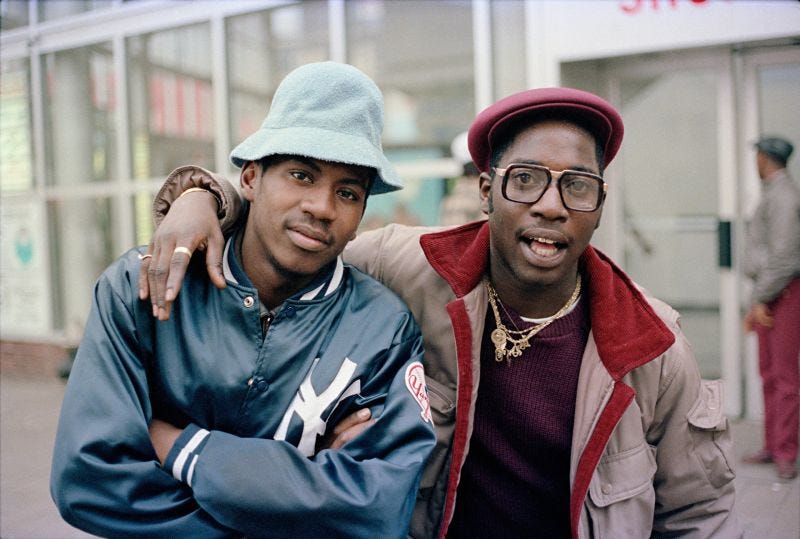
More than sixty photographs make this the first comprehensive account in Germany of Jamel Shabazz’s four decades on the streets of Brooklyn, the Bronx, and Manhattan. Shabazz began working systematically in 1980, after three years in the US Army stationed in West Germany, and the portraits that followed — Black women, men, and children presenting their outfits and their stances directly to a camera held by someone from their own block — became the visual record of hip-hop’s first generation. The exhibition sets that work against the pictures he made across more than twenty years as a correction officer in institutions including Rikers Island, where the same attentiveness is turned on lives interrupted. Curated by Anne-Marie Beckmann with Galerie Bene Taschen; access is by guided tour or on the foundation’s Open Saturdays, October 31 and January 16.
Robert Frank: Mabou / John Cohen: Pull My Daisy
Les Douches la Galerie, Paris
September 4 – October 31, 2026
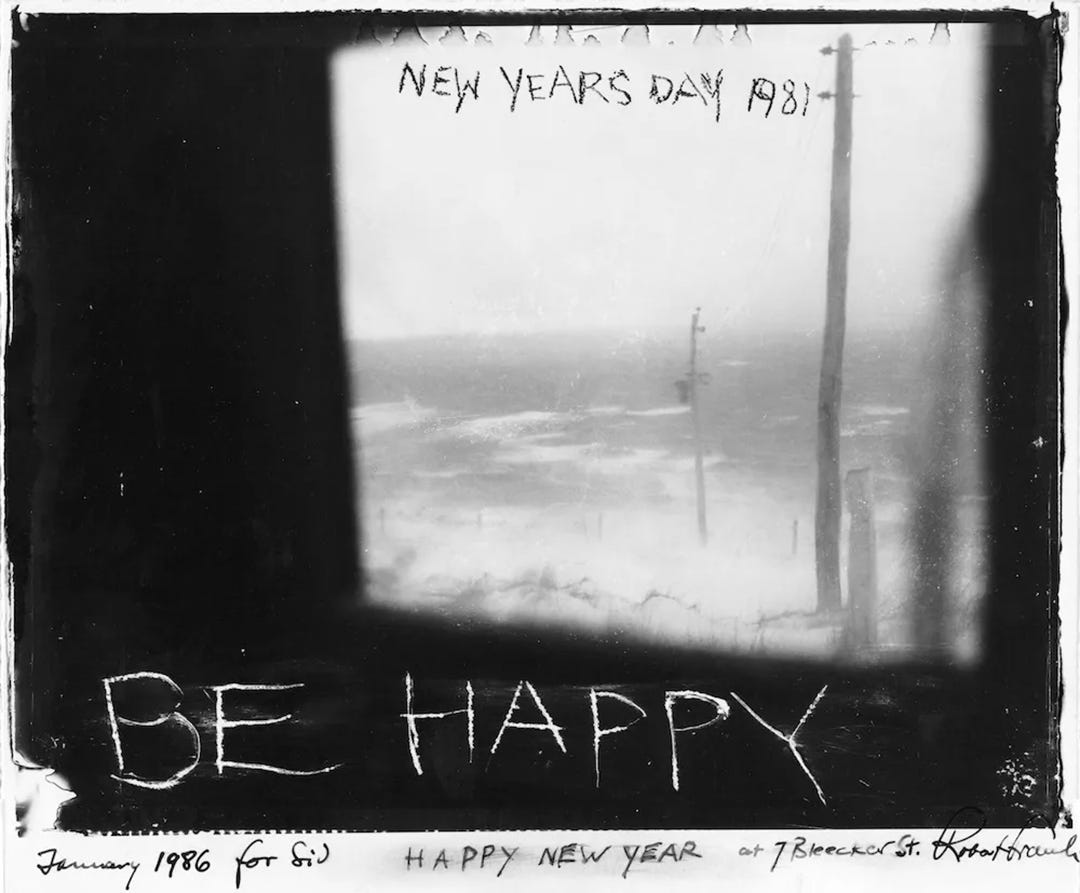
In the summer of 1958, with Les Américains already at the printer, Robert Frank decided that still photographs were too mute — that they needed words, sound, and movement — and made the film Pull My Daisy with Alfred Leslie, Allen Ginsberg, and Jack Kerouac. He asked his neighbor John Cohen, folk musician and founder of The New Lost City Ramblers, to shoot the stills. What Cohen produced is not a set of movie stills but an insider’s record of Gregory Corso, Peter Orlovsky, Larry Rivers, Delphine Seyrig in her first film role, and Frank’s own wife and son, made during a landmark of what became the New American Cinema. The gallery pairs them with Frank’s later Mabou pictures from Nova Scotia, where he went after the films. The accompanying text is by the photography historian Stuart Alexander.
Lee Friedlander: The Shape of Seeing. Early Vintage Prints
Zander Galerie, Paris
September 3 – 26, 2026
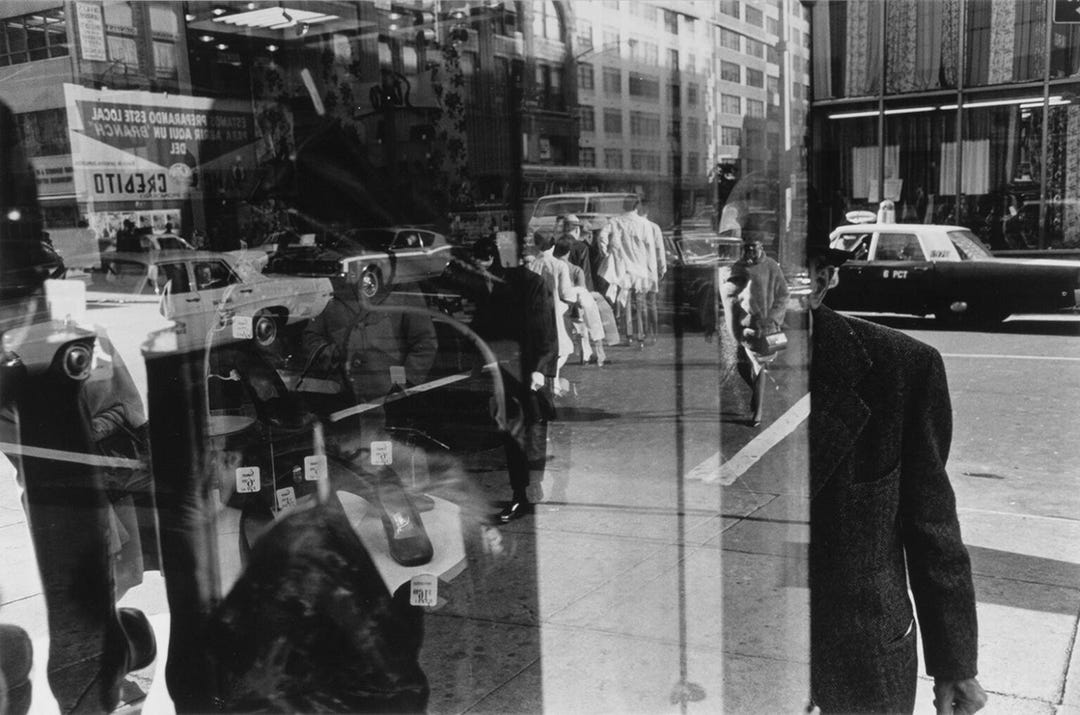
Ten gelatin silver prints, all shot and printed by Friedlander himself in the 1960s and 1970s — the decade that took him from obscurity into John Szarkowski’s New Documents at MoMA in 1967, alongside Diane Arbus and Garry Winogrand. The selection is deliberately small and deliberately dense: faces vanishing behind advertising posters, passers-by fusing with reflections in shop windows, landscapes arriving unannounced in rear-view mirrors, the photographer himself slipping into the frame as a shadow. They read as snapshots and are nothing of the kind. Friedlander turns ninety-two this year, and the show opens the same month Fraenkel Gallery publishes Maria, his book of seven decades of photographs of his wife.
Divination: Beverly Buchanan & Dionne Lee
Contemporary Arts Museum Houston
September 4, 2026 – February 14, 2027
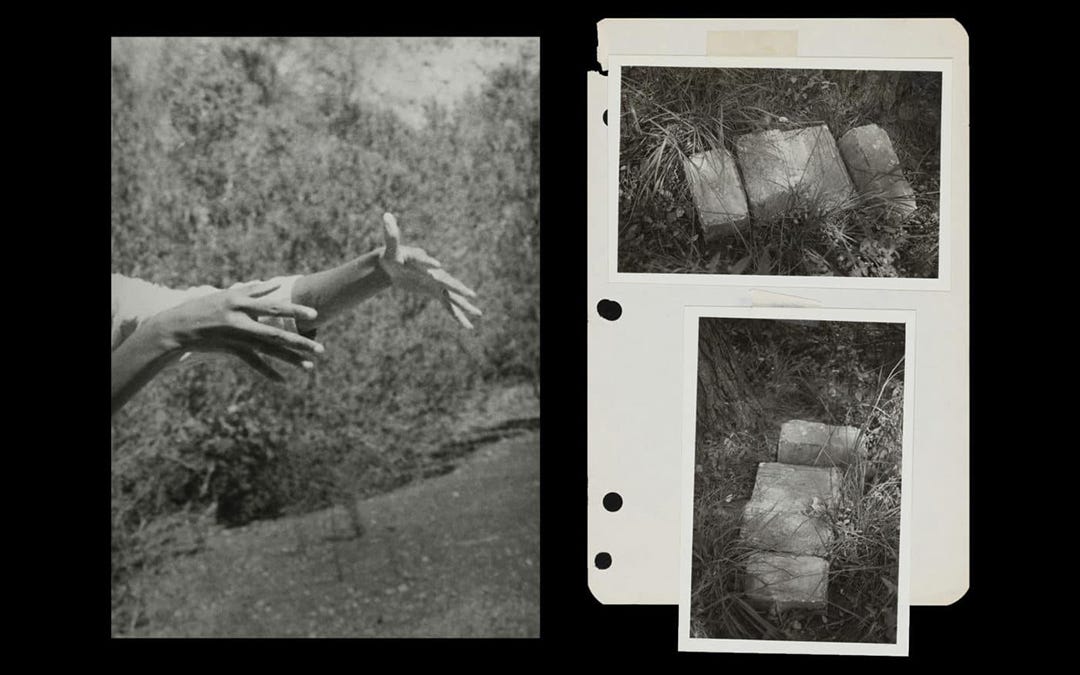
Beverly Buchanan (1940–2015) is known for cast-concrete sculpture and for the small “shack” works memorializing self-built homes in rural Georgia, but she also photographed constantly — documenting her own covert placements of concrete pieces in the graveyards of enslaved people across the state, an auto-archival practice that has never been the subject of a show. CAMH pairs that material with the photographs, films, and sculptures of Dionne Lee, born in 1988 and a 2025 Guggenheim Fellow, whose work approaches the American landscape through survivalist technique and hidden history. Curated by Senior Curator Rebecca Matalon as the second in a series pairing artists across generations, with a risograph catalogue including new writing by the scholar Elleza Kelley.
Robert Ellis: The Forbidden Sun
Photo Museum Ireland
August 29 – October 11, 2026
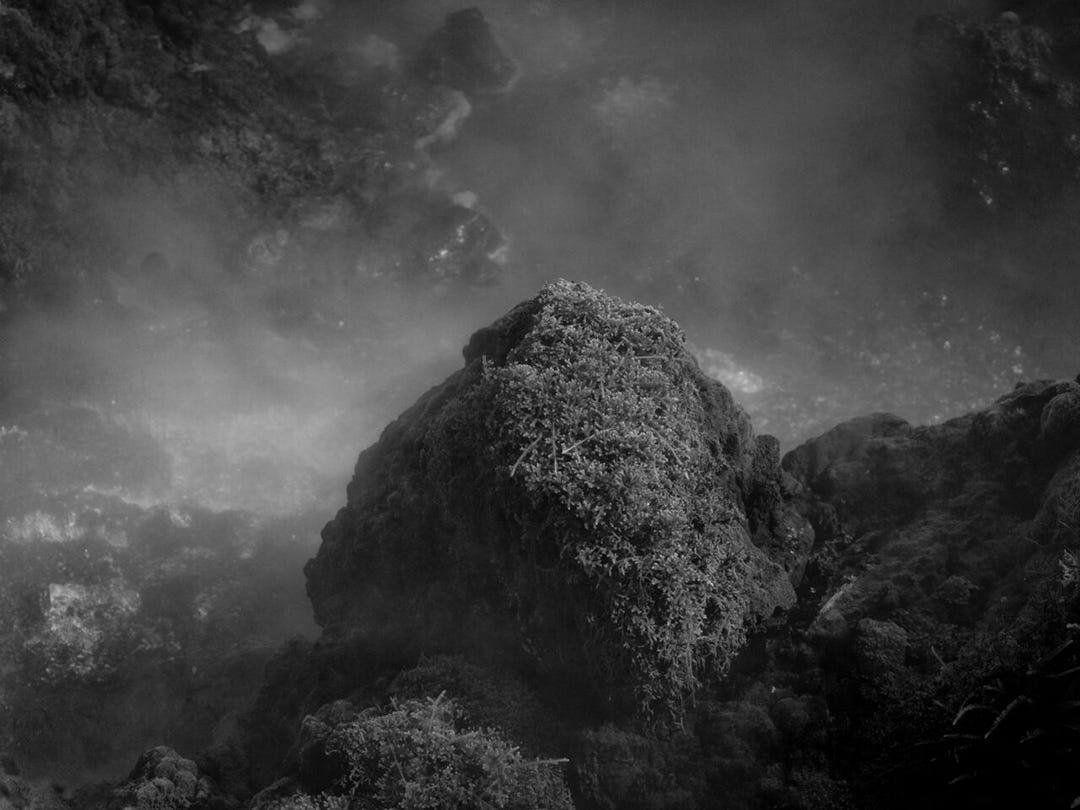
Robert Ellis takes his title from Jennifer Johnston’s How Many Miles to Babylon, a novel he read as a teenager and admired for its restraint, and the photographs work the same way. Steam rises off geothermal ground; quarry machinery grinds stone into sand bound for concrete; nothing in the frame tells you where you are. Ellis has described the work as rooted in growing up queer and closeted in rural Ireland, where identity was negotiated rather than declared, and the landscapes carry that atmosphere of things left unsaid — but the arc of the show rejects the closet rather than describing it. Supported by an Arts Council Project Award; the official opening is Thursday, September 3.
WHAT’S ON AROUND THE WORLD
Opening This Week
Brussels
Still Lives part 2 — Stieglitz19 · Opens Sep 5 (Roger Ballen, Alexandra Catiere, Chen Wei, Pixy Liao, Yusuf Sevinçli, Wolfgang Tillmans)
Cologne
August Sander: Facetten eines Werkes — Landschaft. Architektur. Portrait. — Galerie Julian Sander · Opens Sep 5 (through Dec 19)
Düsseldorf
Irmel Kamp — Linn Lühn · Opens Sep 4 (DC Open; architectural photography)
Valérie Belin: Le songe des idoles — Van der Grinten Galerie · Opens Sep 5
Eva Rubinstein: Proof of Life — Schloss und Park Benrath · Opens Sep 4 (her first solo museum show in Germany)
The Hague
Eva Besnyö: The Liberated Camera — Fotomuseum Den Haag · Opens Sep 5 (through Jan 31, 2027)
Leipzig
Heidi Specker: DamenzimmerHerrenschnitt. Eine Hommage an Aenne Biermann — GfZK · Opens Sep 5
Paris
Wolfgang Tillmans: Glade / Clairière — Galerie Chantal Crousel · Opens Sep 5 (through Oct 10)
Prague
Adam Holý: Afterglow — Fotograf Gallery · Opens Sep 4 (ten years after the photographer’s death)
San Francisco
Eternal Paris: Photographing the City of Light — Legion of Honor · Opens Sep 5 (some 50 works, Marville and Atget onward)
Closing Soon
Buenos Aires
Imagen técnica y cultura material I: Jorge Luis Borges — Rolf Art · Closes Sep 10
New York
Book Wall: Fuego Camina Conmigo — International Center of Photography · Closes Sep 1
Andrea Hernández Briceño: Fire Becomes Spirit — International Center of Photography · Closes Sep 13
Zurich
The Everyday Sacred — Anna Gerasimova — Photobastei · Closes Sep 6
Ongoing
A rotating selection of shows worth the trip, beyond the openings and closings above.
Cambridge, MA
Freezing Time: Edgerton and the Beauty of the Machine Age — MIT Museum · Through Nov 29
New York
Yves Saint Laurent and Photography — International Center of Photography · Through Sep 28
Photobooks USA 2000–25 — International Center of Photography · Through Sep 28
Paris
Daido Moriyama — Fondation Henri Cartier-Bresson · Through Oct 4
Nuits Balnéaires — Fondation Henri Cartier-Bresson · Through Oct 4
Venice
Lorna Simpson: Third Person — Punta della Dogana · Through Nov 22
FESTIVAL WATCH
Biennale Images Vevey 2026 (10th edition): We Are Family! — Vevey, Switzerland · Sep 5 – 27 (roughly 50 site-specific indoor and outdoor installations; Siân Davey, Cristina De Middel, Sunil Gupta, JR, Erik Kessels, Pacifico Silano)
Landskrona Foto Festival 2026 (10th edition) — Landskrona, Sweden · Sep 4 – 20 (ten large-scale outdoor exhibitions across public space, plus an indoor program; Thu–Sun, 12–17)
Stirling Photography Festival 2026: Journey — Stirling, Scotland · Through Sep 30 (ninth edition, free throughout; includes Jill Furmanovsky’s Rebels and Renegades at the Tolbooth)
OFF THE PRESS


Christopher Street by Sunil Gupta
Christopher Street was a cruising ground before it was a symbol — men meeting in the backs of parked trucks, in warehouses left to rot, on jetties nobody was policing anymore — and Sunil Gupta was walking it with a camera in the mid-1970s, a few years after Stonewall, while a generation moved out of the shadows and into the daylight of the street. The black-and-white frames from that series are among the most reproduced images of gay New York before AIDS. This revised edition sets them beside the color work Gupta made alongside them, most of which has never been published, and the shift in register is the point: color makes the whole thing look less like history.
Derselbe Himmel by Ute Mahler
Ute Mahler started making fashion photographs in 1975, straight out of the HGB Leipzig, and spent the next two decades shooting for Sibylle, the East German magazine that became an unlikely style authority in a country with very little to sell. What is striking about the pictures, collected here for the first time, is where the eye lands: on the face before the clothes. Lifted out of the magazine spread, most of them read as documentary — women, and occasionally men, apparently caught mid-thought rather than posed. Mahler went on to co-found the Ostkreuz agency in 1990. The book accompanies her show at Galerie Pankow in Berlin, which opens Sept. 2.
Dark Line — The Thames Estuary by Nadav Kander
Nadav Kander’s first book with GOST gathers photographs made between 2015 and 2024 along the stretch where the Thames widens out of London and meets the North Sea — the same water Turner painted for its light, now known, when it is known at all, for grey marshes and mudflats. Kander has photographed the Yangtze and the American West and the faces of world leaders; the publisher calls this his most personal body of work, and it is the first time the series has been presented complete.
OPEN CALLS
Magnum Foundation Fall 2026 New York City Fellowship — Sep 1, 11:59pm ET · free to enter; NYC-based early-career photographers and photojournalists; production grant, mentorship, and arts administration experience
PhotoPlace Gallery: Quiet Landscape — Beauty, Stillness, and Connection — Sep 7 · juried by Kat Kiernan of the Morgan Library & Museum; $39 for five images; up to 35 works in the gallery plus 40 online
FORMAT27 Open Call: Play — Sep 7 · €27; up to five projects exhibited at FORMAT27 in Derby with a £1,000 artist fee plus production
VSCO — The Fifty: 50 Billboards, 50 States — Sep 10 · no fee; US residents 18+; one photographer per state gets a billboard, with licensing and compensation
Praxis Gallery: The Streets — Sep 13, 11:59pm CT · juried by Jonathan Pavlica; $35 for up to five images, fee waivers on request; exhibition Oct 17 – Nov 14 in Minneapolis
PH21 Gallery Barcelona: Monochrome — Sep 14 (early bird Sep 7) · curated by Zsolt Bátori and Borbála Jász; from €25, €15 concessions; exhibition Nov 14 – Dec 8 in the Gothic Quarter
RSA Elizabeth Lornie Photography Award 2026 — Sep 20, 5pm · £5,000 plus exhibition and acquisition into the RSA Permanent Collections; Scottish-born, Scottish-trained, or three years’ residency
Arnold Newman Prize for New Directions in Photographic Portraiture 2026 — Sep 23, 11:59pm EST · $20,000 to the winner, $500 to each of three finalists, Top Ten published
2026 Lucie Scholarship Program — Sep 30 · $25 professional / $15 emerging; four cash grants across Fine Art and Photojournalism/Documentary plus a touring group show
James Balog Earth Vision Awards — Oct 1 · newly announced biennial endowed by James Balog; $40,000 first prize, $25,000 finalist prize, winning work enters the Denver Art Museum collection; still photography only, no video or AI
PhMuseum 2026 Women Photographers Grant (10th edition) — opens Sep 8; early bird Sep 19, final Oct 10 · $11,000 in prizes and a solo show at PhMuseum Lab; jury of Elisa Medde, Mariela Sancari, Yagazie Emezi, and Myriam Boulos
The Photographers’ Gallery Open Call — Future of Archives: Whose Archive is it Anyway? — Nov 1
ON THIS DAY
September 4, 1888 — George Eastman receives patent number 388,850 for the shutter of the Kodak camera, and trademark number 15,825 for the word “Kodak.” The camera had gone on sale earlier that summer: $25, pre-loaded with enough film for 100 circular exposures, no adjustments and no prior knowledge required. The user pulled a string to arm the shutter, pointed, and pressed. When the roll was finished the whole camera went back to Rochester, where the film was developed, prints were returned, and the camera came back reloaded — a system Eastman advertised with the line “You press the button, we do the rest.” Photography stopped being a profession that week and started being a reflex; the company changed its name to Eastman Kodak in 1892 on the strength of it. George Eastman Museum

THE INTERNATIONAL REVIEW OF PHOTOGRAPHY
To advertise an exhibition, book, fair, or open call to photography collectors, curators, and gallerists worldwide, email internationalphotographynews@gmail.com
Who wrote this?
I adore the work of Marc Riboud. I owned a signed, 16 x 20 print of "Peintre de la tour Eiffel, Paris, 1953." It spent ten years on my living room wall before, regrettably, I sold it.
But I have a bone to pick with the comments posted here about what that photograph represents.
A career does not—indeed cannot—turn on a single frame or be defined by it. Not even for Marc Riboud. A career in photography and the intentionality it represents can only accrue through practice over time, revealing itself ultimately in what is called a body of work.
A body of work is the cumulative expression of an artist’s way of seeing, assembled less by design or forethought than by consistency of execution and values—over time. One photograph just doesn’t do it.
This is not taxonomical nitpicking. It makes a consequential difference in the understanding of photography—all art. Any kind of flattening is problematic because each term describes a different scale of artistic intention.
Confusion begins when four terms are so often used interchangeably in photographic circles:
• Series
• Project
• Portfolio
• Body of work
A series is bound by recurring formal or conceptual constraints. A project is broader, defined by a sustained subject or organizing principle. A portfolio is logistical, not conceptual. An then, of course, there is an artist’s body of work.
A body of work accrues across decades of encounters with myriad subjects, through recurrence, judgment, risk, failure, revision, and sustained attention. A body of work is not the announcement. It is the residue: what remains after enough individual photographs have accumulated to reveal an ethos rather than a method.
Yet a single photograph can certainly achieve iconic status—powerful enough to remain in the public’s consciousness as a definitive example of one photographers entire opus, such as "Peintre" certainly does, even though it captures merely one aspect of Riboud’s career at a passing moment.
The example of Yousuf Karsh’s portrait of a glowering Winston Churchill also comes to mind. Its power is often taken as proof that a powerful photograph can capture a person’s essence. But Churchill was glowering only because Karsh, without warning, stepped in front of his camera and plucked a cigar from Churchill’s mouth, then snapped the shutter.
One portrait like that can kick-start a photographer’s career, as it did for Karsh. But even though I’ve just compared one kind of photograph—oh, hell, let’s call it a towering example of “street photography” to another kind, a portrait, I can’t think of a single photograph that has defined a photographer’s career. Riboud’s career was not exacly bupkis at the time he made "Peintre."
It takes a lifelong body of work to define a photographer’s career, not just one iconic photograph.