

THE FRAME
Fourteen Photographers, One Face: What Marilyn Monroe Understood About the Camera
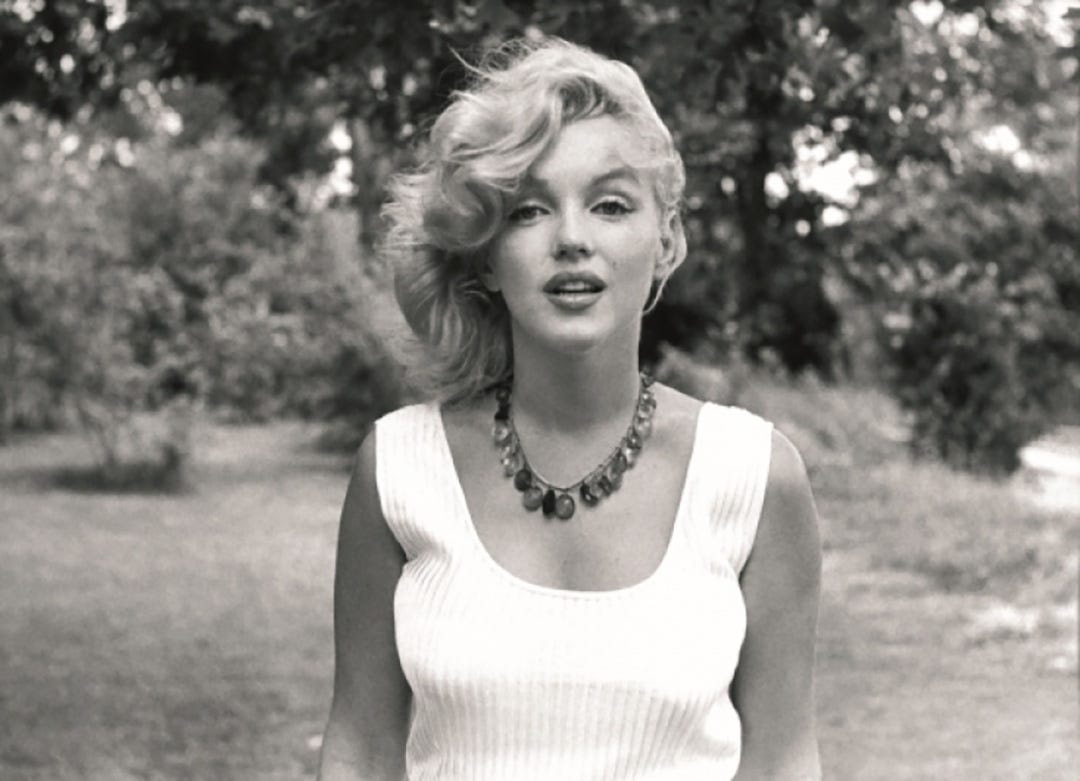
This coming Saturday, May 30, Peter Fetterman Gallery in Santa Monica opens Marilyn Monroe: A Silent Life, a major photographic exhibition that gathers the work of the photographers who shaped — and witnessed — the most photographed woman of the twentieth century. The roster is extraordinary: Eve Arnold, Henri Cartier-Bresson, Cornell Capa, André de Dienes, Elliott Erwitt, Allan Grant, Philippe Halsman, Douglas Kirkland, Milton Greene, Inge Morath, Lawrence Schiller, Sam Shaw, and Bert Stern, among others. Few subjects in the history of the medium have been photographed by so many of its masters.
What makes the exhibition more than a parade of famous images is its argument about performance. Monroe is often remembered through the unguarded frame — searching, alone, caught between takes. But A Silent Life gives equal weight to the artifice: the studio sessions, the magazine assignments, the constructed photographs in which a performer acutely aware of the lens shaped and reshaped herself in real time. The exhibition moves fluidly between the two registers, and refuses to treat one as more truthful than the other.
The result is a layered portrait — not a single narrative but a study of the space between the composed and the candid, the myth and the inner life that flickers beneath it. A publicity still carries an unexpected stillness; a snapshot feels quietly staged.
WHY IT MATTERS
A show about the most photographed woman of the century is really a show about authorship — about who makes an image when a subject knows exactly how to be seen. Fourteen photographers, one face, and a reminder that the camera never simply records: it negotiates. Visit: Peter Fetterman Gallery
THE PHOTOGRAPH
The Falling Soldier — Robert Capa, 1936
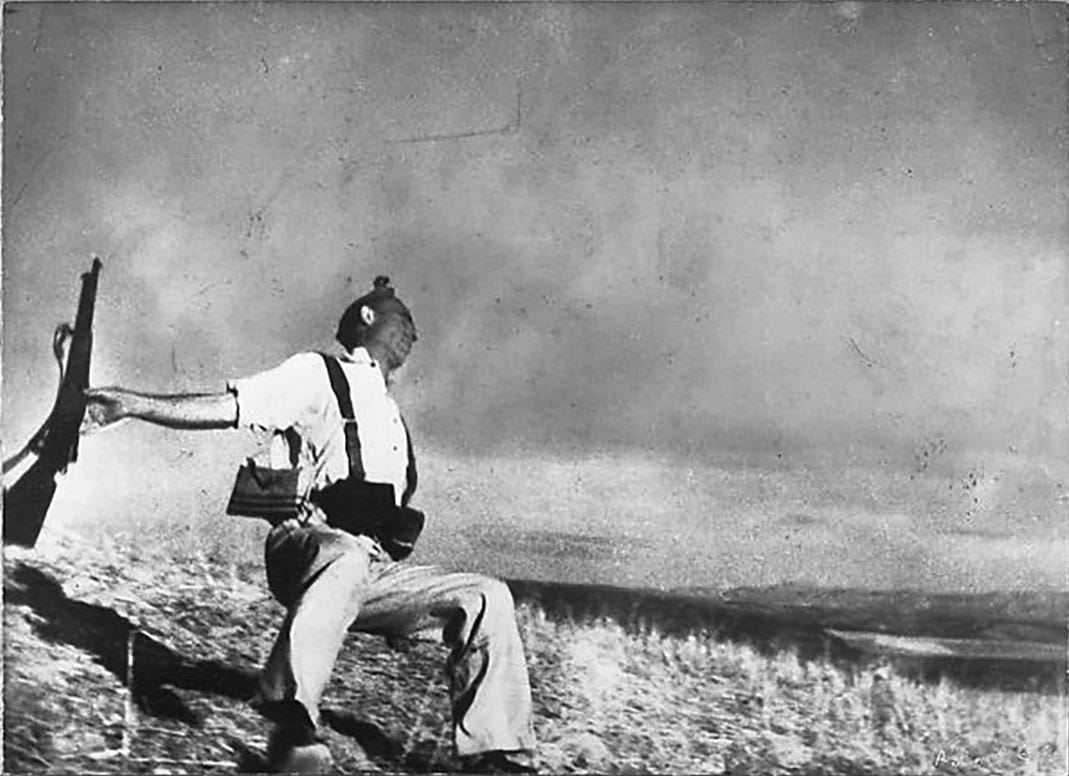
No single image defined twentieth-century war photography more completely — or more contentiously — than Robert Capa’s The Falling Soldier. Made on the Córdoba front during the Spanish Civil War and first published in the French magazine Vu in September 1936, then in Life the following year, the photograph appears to capture a Republican militiaman at the precise instant of death, arms flung back, rifle slipping from his hand as he collapses on a grassy slope. It became the photograph of the Spanish Civil War, and one of the most reproduced war images ever made.
It has also been argued over for the better part of a century. Researchers have debated whether the image was made under fire or staged during a lull, whether the location was Cerro Muriano or Espejo, and whether the soldier was Federico Borrell García, a militiaman from Alcoy. The International Center of Photography, which holds Capa’s archive, presents the image with that scholarship attached rather than resolved. We feature it this week with a particular date in mind: Capa was killed on May 25, 1954, when he stepped on a landmine while covering the First Indochina War — seventy-two years ago today. The photographer who gave the century its image of a soldier’s death met his own in the field.
ON VIEW
New This Week
Catherine Opie: Holding Blue
Regen Projects
Los Angeles · Opens May 28, 2026
One of the most influential American photographers of the past four decades opens a new exhibition at Regen Projects. Opie built her reputation on portraits of queer communities, on studies of American social architecture — freeways, houses, high-school football — and on a restless willingness to move between subjects. Holding Blue is her latest, and arrives in an LA gallery season unusually rich in photography.
Slice of the Pie
Fraenkel Gallery
San Francisco · May 28 – August 15, 2026
A new summer exhibition at Fraenkel Gallery, one of the longest-standing and most respected photography galleries in the United States. Fraenkel’s group shows have a reputation for wit and unexpected juxtaposition, drawing across the gallery’s deep nineteenth-, twentieth-, and twenty-first-century holdings.
Victoria Sambunaris: Fall Line
Yancey Richardson
New York · May 29 – July 2, 2026
For two decades Victoria Sambunaris has photographed the American landscape at the seam where geology meets industry — rail lines, mines, borders, the engineered terrain of the continent — in meticulous large-format color. Fall Line takes its title from the geographic boundary where upland gives way to coastal plain, and continues her inquiry into how land is shaped, crossed, and claimed.
Mary Ellen Bartley: Color Anthology
Yancey Richardson (Project Gallery)
New York · May 29 – July 2, 2026
Opening the same day in Yancey Richardson’s Project Gallery, Mary Ellen Bartley’s Color Anthology continues her quietly radical practice of photographing books as physical objects — stacked, splayed, abstracted into fields of color and edge. Bartley turns the most familiar object in any reader’s life into a study of form, light, and the materiality of print.
Feel the Beat: Dance in Photographs
SFMOMA
San Francisco · Through January 31, 2027
A new exhibition drawn from SFMOMA’s collection exploring how photographers have confronted one of the medium’s oldest problems: how to hold motion still. Spanning rhythm, gesture, and the charged pause between movements, Feel the Beat runs through the coming winter — a generous window for one of the season’s most ambitious Bay Area photography shows.
Miles Davis: A Century of Cool
Musichead Gallery
Los Angeles · May 16 – June 13, 2026
Marking the centennial of Miles Davis’s birth, Musichead Gallery presents a photographic retrospective of the trumpeter whose image was as carefully composed as his sound. The exhibition gathers the work of photographers who captured Davis across the decades — a study of how one of the twentieth century’s defining musicians was seen, and how he chose to be seen.
THIS WEEK
Openings, closings, launches, talks, and one-day events — May 25 through May 31
Monday, May 25
Abbey Road Music Photography Festival opens in New York — the inaugural edition, with exhibitions, workshops, portfolio reviews, and community events through May 30
Wednesday, May 28
The Continuity of Kinship — Aperture event on Kinship & Community and the Texas African American Photography Archive
Louis Porter: Search Engine launch — book launch, talk, and signing at The Photographers’ Gallery, London
Catherine Opie: Holding Blue opens at Regen Projects, Los Angeles
Slice of the Pie opens at Fraenkel Gallery, San Francisco
World Press Photo Days 2026 begins in Amsterdam — through May 30
Ocean Conservancy Photo Contest 2026 — submissions close
Friday, May 29
Victoria Sambunaris: Fall Line and Mary Ellen Bartley: Color Anthology open at Yancey Richardson, New York
Sabiha Çimen and Mary Ellen Mark: The Girls — final day at Howard Greenberg Gallery, New York
Saturday, May 30
Marilyn Monroe: A Silent Life opens at Peter Fetterman Gallery, Santa Monica
Photoville 2026 — final day at Brooklyn Bridge Park
Sunday, May 31
Catherine Opie: To Be Seen — final day at the National Portrait Gallery, London
FAIR & FESTIVAL WATCH
The international festival calendar is dense this week and into June.
Photoville 2026 runs its final days in New York — 90-plus exhibitions across Brooklyn Bridge Park and all five boroughs, free, through May 30.
World Press Photo Days 2026 convenes in Amsterdam, May 28–30, around the year’s contest and exhibition.
The inaugural Abbey Road Music Photography Festival opens in New York, May 25–30.
Looking into June:
La Gacilly Photo Festival opens June 1, the vast free open-air festival in Brittany running through October 4
Belfast Photo Festival opens June 4
The 9th Triennial of Photography Hamburg opens June 5 under the titleAlliance, Infinity, Love
Athens Photo Festival opens June 10
Copenhagen Photo Festival runs June 11–21, its 17th edition themed Forestillinger / Scenarios
photo basel runs June 16–21 during Art Basel wee
Fotofestiwal Łódź marks its 25th edition June 18–28.
PHotoESPAÑA 2026continues across Madrid through September 13.
OFF THE PRESS
New & Noteworthy
Take a Picture, It Will Last Longer by Brooke DiDonato
Thames & Hudson
The first monograph from Brooke DiDonato, an American photographer whose surreal domestic tableaux have built a substantial following well beyond the gallery world. DiDonato’s images unfold in ordinary rooms — kitchens, bedrooms, backyards — and then quietly break the rules of those spaces: a figure folded into wallpaper, a body half-vanished into a lawn, faces turned away or obscured. The book gathers a decade of this dreamlike, unsettling domestic theatre into a single volume.
Archipelago by Yolanda del Amo
Kehrer Verlag
Yolanda del Amo builds her photographs the way a playwright blocks a scene. Archipelago collects her staged portraits of figures arranged in domestic and natural settings — together in the frame yet held apart by carefully measured distances, gazes that do not quite meet, bodies that occupy the same space without touching. The result is a quiet, exacting study of intimacy and its absences, of how families and couples are bound and separated at once.
Made of Smokeless Fire by Camille Farrah Lenain
Loose Joints
Camille Farrah Lenain’s Made of Smokeless Fire is a portrait of queer Muslim life in France — a body of work built through proximity and trust rather than spectacle. The title draws on the Qur’anic description of the jinn, beings created from smokeless fire, and Lenain uses it to frame a community living between identities that the wider culture often treats as irreconcilable. A tender, politically charged debut from one of Loose Joints’ most distinctive recent signings.


IN THE WEEKS AHEAD
Opening, Closing and Ongoing Exhibitions from Around the World
OPENING SOON
Los Angeles
Marilyn Monroe: A Silent Life — Peter Fetterman Gallery · Opens May 30
Daido Moriyama: The Hunter — Peter Fetterman Gallery · Opens June 6
CLOSING SOON
London
Catherine Opie: To Be Seen — National Portrait Gallery · Closes May 31
New York
Sabiha Çimen and Mary Ellen Mark: The Girls — Howard Greenberg Gallery · Closes May 29
ONGOING
Berlin
Graciela Iturbide: Eyes to Fly With — C/O Berlin · Through June 10
Fort Worth
Black Photojournalism — Amon Carter Museum of American Art · Through July 5
London
Jess T. Dugan: LOVE PICTURES — Curatorial Gallery · Through June 27
Up Close — Hamiltons · Through June 30
Los Angeles
Photography and the Black Arts Movement, 1955–1985 — Getty Center · Through June 14
New York
Chester Higgins: Shared Memories — Bruce Silverstein Gallery · Through June 20
Face Value: Celebrity Press Photography — MoMA · Through June 21
Paris
Nan Goldin: This Will Not End Well — Grand Palais · Through June 21
Santa Monica
Elger Esser: My Days at Ray’s — ROSEGALLERY · Through July 11
OPEN CALLS
Ocean Conservancy Photo Contest 2026 — ocean and marine-wildlife photography · Deadline May 28
European Photography Awards 2026 — international photography awards · Deadline June 3
URBAN Photo Awards 2026 — international photography competition · Deadline June 14
LensCulture Street Photography Awards 2026 — street photography competition · Deadline June 17
Abbey Road Music Photography Awards 2026 — free global music photography awards · Deadline June 30
Lucie Photo Book Prize 2026 — Lucie Foundation photobook prize · Deadline September 15
Lucie Foundation Scholarship Program 2026 — scholarships for emerging photographers · Deadline September 30
ONE QUESTION
Robert Capa’s The Falling Soldier has been argued over for ninety years: made under fire, or staged in a quiet moment between them? Suppose, for the sake of the question, that it was staged. If a photograph’s historical weight and emotional truth are undiminished — if it still tells us something true about that war and about war itself — does it matter whether the instant it depicts was authentic? Where should documentary photography draw the line between an image that records a moment and an image that represents one?
Reply with your view. The most interesting responses appear in next week’s issue.
DID YOU KNOW?
Robert Capa was, in a sense, invented. In Paris in the mid-1930s, the Hungarian photographer Endre Friedmann and his partner, the German photographer Gerda Pohorylle, were struggling to sell their work. So they created a character: “Robert Capa,” a famous, successful, and entirely fictional American photographer whose pictures — they told editors — commanded premium prices. The ruse worked until it was discovered, at which point Friedmann simply became Robert Capa for the rest of his life. Pohorylle, meanwhile, took the name Gerda Taro and became a celebrated war photographer in her own right before she was killed covering the Spanish Civil War in 1937, at twenty-six.
The invented photographer became real in every sense: in 1947 Capa co-founded Magnum Photos, the photographer-owned cooperative that remains the most influential agency in the medium — and his close-in, in-the-action style became a template for modern visual storytelling. The marketing fiction did not just come true; it reshaped the craft.
ON THIS DAY
May 26, 1895 — Dorothea Lange is born Dorothea Margaretta Nutzhorn in Hoboken, New Jersey. At seven she contracted polio, which left her with a lasting limp; she later said of it, “It formed me, guided me, instructed me, helped me and humiliated me. I’ve never gotten over it, and I am aware of the force and power of it.” Lange went on to become the defining documentary photographer of the Great Depression, her work for the Farm Security Administration — above all Migrant Mother (1936) — fixing the era in the American imagination. She would help found the magazine Aperture in 1952 and become, in 1966, the first woman granted a solo retrospective at the Museum of Modern Art.

THE INTERNATIONAL REVIEW OF PHOTOGRAPHY
To advertise an exhibition, book, fair, or open call to photography collectors, curators, and gallerists worldwide, email internationalphotographynews@gmail.com
Have you heard this song?