THE FRAME
From 240,000 Miles Away, Four Astronauts Took Some of the Most Significant Photographs in History
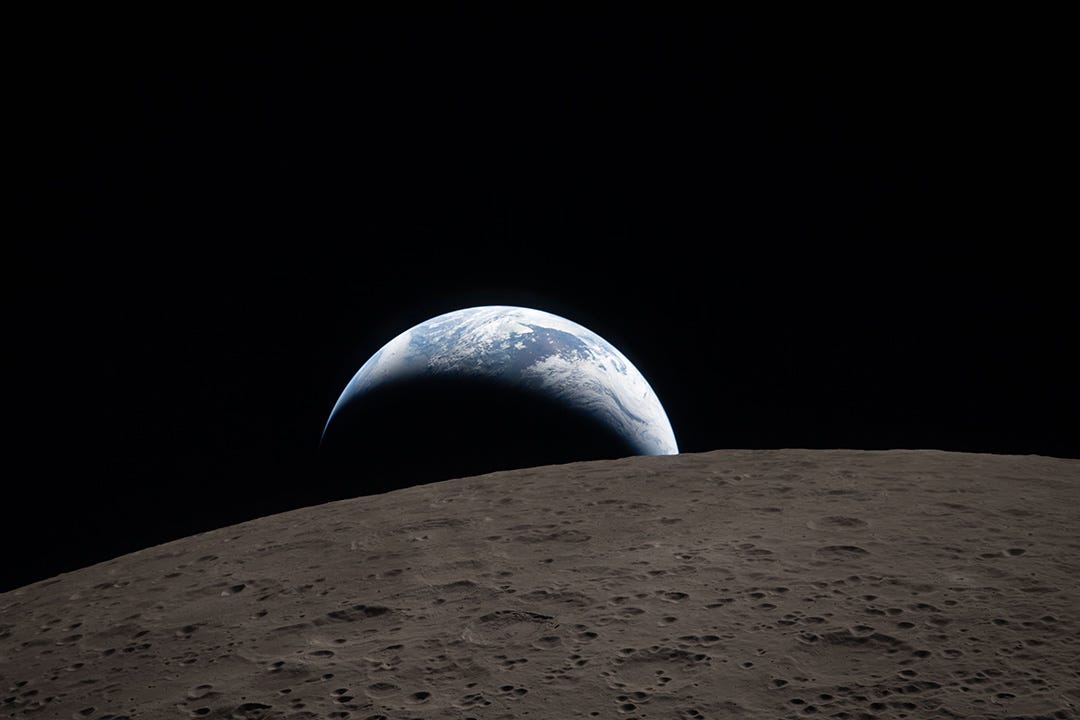
On April 6, 2026, the four-person crew of NASA’s Artemis II mission completed a seven-hour flyby of the Moon — the first time humans had traveled that far from Earth since Apollo 17 in December 1972. What they brought back, transmitted digitally to Earth the following day, was not just mission data. It was a new chapter in the history of photography.
The crew — Commander Reid Wiseman, Pilot Victor Glover, and Mission Specialists Christina Koch and Jeremy Hansen — had undergone weeks of photography training with an array of Nikon digital cameras and iPhones. The Orion spacecraft was equipped with five live-streaming cameras and twice as many windows as the Apollo capsules. What they captured during 54 minutes of totality, as the Moon completely eclipsed the Sun from their vantage point above the lunar surface, had literally never been seen before: the Sun’s corona visible in full detail against a dark disc, stars appearing in the background, the near side of the Moon faintly lit by light reflected off the Earth from a quarter million miles away.
They also updated one of the most viewed photographs in history. In 1972, Apollo 17 geologist Harrison Schmitt captured the Blue Marble — Earth fully illuminated by the Sun, approximately five hours into the mission. It became one of the defining images of the 20th century, used by Al Gore in An Inconvenient Truth and reproduced billions of times. The Artemis II crew captured Earth at the same mission milestone, but illuminated by the Moon’s glow instead of direct sunlight. That’s Earth 2026 alongside Earth 1972 — both singular documents of a moment in our planet’s long history.
The images are now part of NASA’s Artemis II gallery, with more expected as the mission archive is processed. In an era of AI-generated deep fakes, the space historian Jennifer Levasseur notes, the authenticity of these images matters in a new way: “Entire generations born after Apollo 17 may hardly believe the reality of Artemis II.” The photographs are real. Four people made them, pressing the shutter from a window above the Moon.
WHY IT MATTERS
Photography has been to the Moon before. But the Artemis II images arrive in a different moment — when the credibility of images is under sustained attack, when AI can fabricate anything, and when the question of what photographs can be trusted has never been more urgent. These images are unrepeatable. They were made by four people, with cameras, from a spacecraft, above the surface of the Moon. That fact matters to photography in ways that go beyond space exploration.
THE AUCTION BLOCK
The spring photography auction season is now complete. Across Phillips and Sotheby’s, the market delivered strong signals at the top — led by one result that no one saw coming.
Phillips Photographs — New York, April 11
Total realized: $5,038,224. The standout result of the season: Tina Modotti’s Bandolier, Corn, Sickle (1927) sold for $645,000 — four times its high estimate of $150,000. A 1927 gelatin silver print of a rifle strap, an ear of corn, and a sickle became the most talked-about photograph at auction this spring. Other confirmed results above estimate: Sally Mann’s Vinland at $41,280 (est. $20,000–30,000); Thomas Ruff’s phg.11 at $47,730 (est. $25,000–35,000). Wolfgang Tillmans’s Freischwimmer 123, Cindy Sherman’s Untitled Film Still #49, and the Richard Avedon The Family are all confirmed sold; final prices pending Phillips’s complete press release. Phillips results
Sotheby’s Photographs Part II — Online, closed April 16
Over 100 lots across a wide range of photographers, led by Diane Arbus’s Identical Twins, Roselle, N.J. and Helmut Newton’s Blonde and T.V., Hotel Gallia, Milan. Full results pending publication. Sotheby’s results
FAIR & FESTIVAL WATCH
Opening This Week
AIPAD: The Photography Show
Park Avenue Armory, New York
April 22–26, 2026
45th edition. 77 galleries from 15 countries. New “Focal Point” single-artist sector. AIPAD Award to Deborah Willis presented at the VIP opening April 22. Willis in conversation with Aperture’s Brendan Embser on April 23 at 1pm. Aperture Portfolio Prize awarded during the fair.
World Press Photo Exhibition
De Nieuwe Kerk, Amsterdam
April 24 – September 27, 2026
Flagship Amsterdam venue for the 2026 contest winners. The World Press Photo of the Year is announced April 23, one day before the exhibition opens. All regional and category winners on view. Free entry.
Photobooks Switzerland
Bibliothèque de Genève, Geneva
April 24–26, 2026
6th edition. Switzerland’s leading annual photobook fair, with a new partnership with the Bibliothèque de Genève. Publishers, artists, and collectors.
Fotografia Europea
Reggio Emilia, Italy
April 30 – June 14, 2026
21st edition. Theme: Ghosts of the Moment. City-wide exhibitions, portfolio reviews, screenings, and workshops across Reggio Emilia.
IN FOCUS
Deborah Willis Has Been Correcting the Historical Record for Four Decades. AIPAD Just Gave Her Its Highest Honor.

When Deborah Willis began researching the history of Black photographers in the 1970s, she found almost nothing in the existing literature — not because Black photographers didn’t exist, but because the institutions that maintained the canon had largely ignored them. Willis spent the next five decades fixing that, one archive at a time.
Her landmark publication, Reflections in Black: A History of Black Photographers, 1840 to the Present (2000), documented over 1,000 Black photographers for the first time in a single volume — a project that required decades of primary research across libraries, private collections, community archives, and family albums. Reissued in 2025 with 130 new images, it remains the definitive work in the field. Before Willis, the standard histories of photography barely registered the contributions of Black photographers at all.
Willis is University Professor and Chair of the Department of Photography & Imaging at NYU’s Tisch School of the Arts, where she has shaped generations of photographers over nearly twenty-five years. She is a recipient of both the MacArthur “Genius” Fellowship and the Guggenheim Fellowship. Her other publications include Picturing Us: African American Identity in Photography (1996) and Posing Beauty (2009). She is also a working photographer — her images exploring representations of the Black body, women, family, and identity.
This Wednesday, April 23, Willis receives the 2026 AIPAD Award at The Photography Show’s VIP opening at the Park Avenue Armory — AIPAD’s highest honor, presented to individuals who have made an exceptional contribution to the field. She will be in conversation with Brendan Embser, Senior Editor at Aperture, on Thursday, April 24 at 1pm. AIPAD
WHY IT MATTERS
“Deb’s work and influence have meaningfully altered how photography and photographers are viewed, discussed, and represented both behind and in front of the camera,” said AIPAD executive director Lydia Melamed Johnson. “Spanning scholarship, curatorial work, artistic practice, and her tireless support of and mentorship to the defining voices of previous generations and our present moment, her contributions to our medium, in the broadest possible sense, cannot be overstated.” The canon Willis reshaped is not a minor revision. It is the foundation on which any serious history of photography now rests.
OFF THE PRESS
New & Noteworthy
Life Still by Lee Friedlander
Aperture
Since the 1960s, Lee Friedlander has created incisive, often witty photographs of the American social landscape, shaping our appreciation of the quirks, charms, and idiosyncrasies of everyday life. In his latest monograph, he brings together rarely seen and never-before-published images from his vast archive alongside new work, staging a visual dialogue between past and present. Fractured reflections in shop windows, deadpan domestic scenes, roadside signage. Friedlander’s polychronic vision of American ubiquity is as comforting as it is alienating — the irony, humor, and self-conflict of the American consciousness, as vivid today as it ever was.
Snow by Sohrab Hura
MACK
Kashmir has been at the center of disputes between India, Pakistan, and China since 1947. Sohrab Hura photographed the Indian-administered region over five years, tracing the three distinct phases of its winter: Chillai Kalan (harsh cold), Chillai Khurd (small cold), and Chillai Bache (baby cold). The snowmelt evokes the wearing down of illusions. Picturesque landscapes give way to residual markers of conflict and violence. Kashmir has been marketed to Indian tourists as a place to experience snow — all the while remaining one of the most heavily militarized regions in the world. Hura’s book holds that contradiction without resolving it. The first in a pair of publications; a forthcoming volume will explore Barwani, Madhya Pradesh. Signed edition available.
Absentee by Sayuri Ichida
Benrido
UK-based Japanese artist Sayuri Ichida uses her own body as the sole subject in this intimate portfolio — exploring what the word “absentee” suggests: a sense of detachment from oneself, from reality, from presence. After more than a decade in commercial photography, Ichida completed her MA in Photography Arts at the University of Westminster and is now based in Margate, England. Her work has been exhibited internationally and is held in the VERBUND COLLECTION and Museum Voorlinden. A quiet, necessary counterpoint to the maximalism of contemporary image culture.


OPEN CALLS
Deadlines This Month
Inge Morath Award 2026 — Deadline April 30. No fee. $7,500 from the Magnum Foundation for women and nonbinary photographers under 30. One finalist also receives $1,000.
IN THE WEEKS AHEAD
Key Dates: Through April 30
Apr 22: AIPAD: The Photography Show VIP opening, Park Avenue Armory, New York. AIPAD Award to Deborah Willis presented.
Apr 22–26: AIPAD: The Photography Show open to public. 77 galleries, 15 countries.
Apr 23: World Press Photo of the Year 2026 announced (11:00am CEST).
Apr 23: Deborah Willis in conversation with Aperture’s Brendan Embser at AIPAD (1pm).
Apr 24: World Press Photo Exhibition opens, De Nieuwe Kerk, Amsterdam (through Sep 27).
Apr 24–26: Photobooks Switzerland, Geneva. 6th edition.
Apr 25: Last day — Binh Danh & Renee Royale, ROSEGALLERY, Santa Monica.
Apr 25: JR: Horizons, Perrotin, Los Angeles.
Apr 30: Deadline — Inge Morath Award.
Apr 30: Fotografia Europea opens, Reggio Emilia (through Jun 14).
ONE QUESTION
Vivian Maier made over 150,000 photographs. She showed them to almost no one. Her estate was sold at auction after her death — and the buyers became the custodians of her legacy. Who should own a photographer’s archive when the photographer is gone?
Tell us what you think in the comments. We’ll highlight the best responses next issue.
DID YOU KNOW?
There are 12 Hasselblad cameras sitting on the Moon right now — and they’ll be there essentially forever. During the Apollo missions, astronauts had strict weight limits for their return journey. So they left the camera bodies behind, taking only the film magazines. The cameras remain on the lunar surface, sealed in their original configurations, in a near-perfect vacuum. No rust, no decay. They are almost certainly the best-preserved cameras in existence.
ON THIS DAY
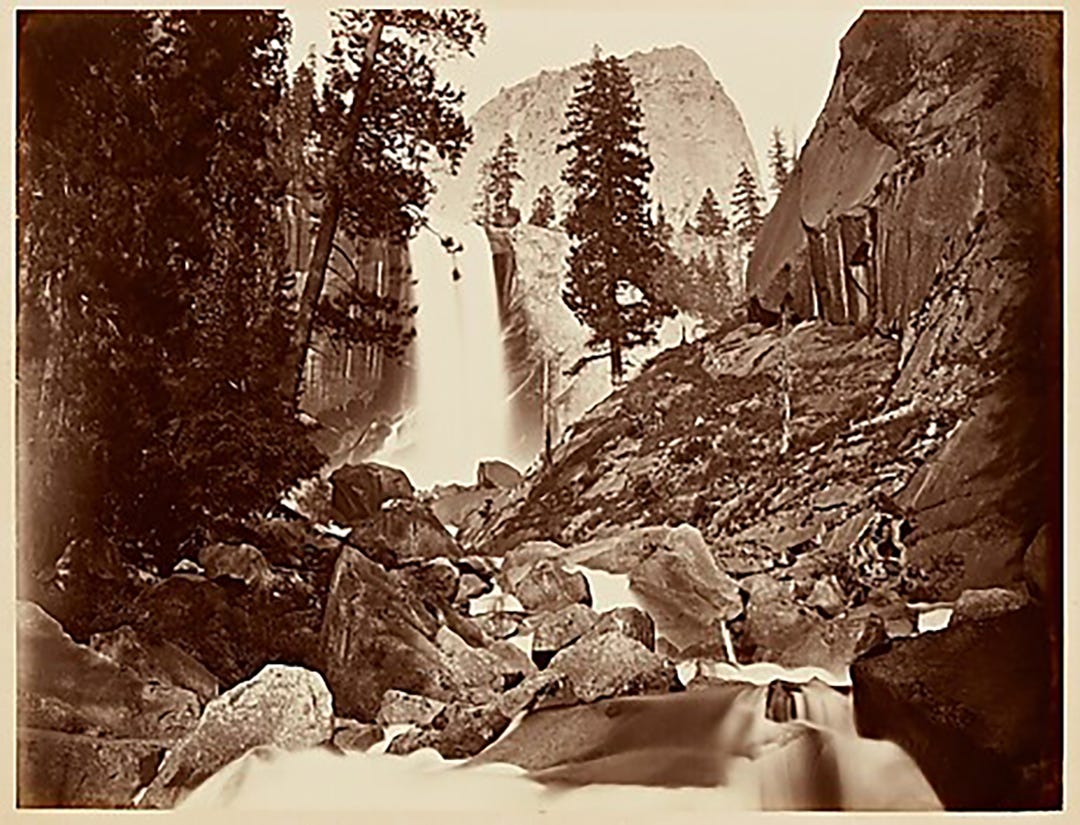
April 22, 1970: The first Earth Day was observed across the United States, with 20 million people participating in rallies, teach-ins, and cleanups. The day galvanized the modern environmental movement — but environmental photography predates it by more than a century. Carleton Watkins photographed Yosemite Valley in the 1860s; his images were presented to Congress and directly contributed to Abraham Lincoln signing the Yosemite Grant in 1864, the first time the federal government protected land specifically for public use. Ansel Adams continued that tradition for decades, lobbying Congress with his prints. By the time Earth Day arrived in 1970, photographers had been making the environmental argument for over a hundred years.