

THE FRAME
The Morgan Library Opens the Most Intimate Exhibition in Peter Hujar’s History
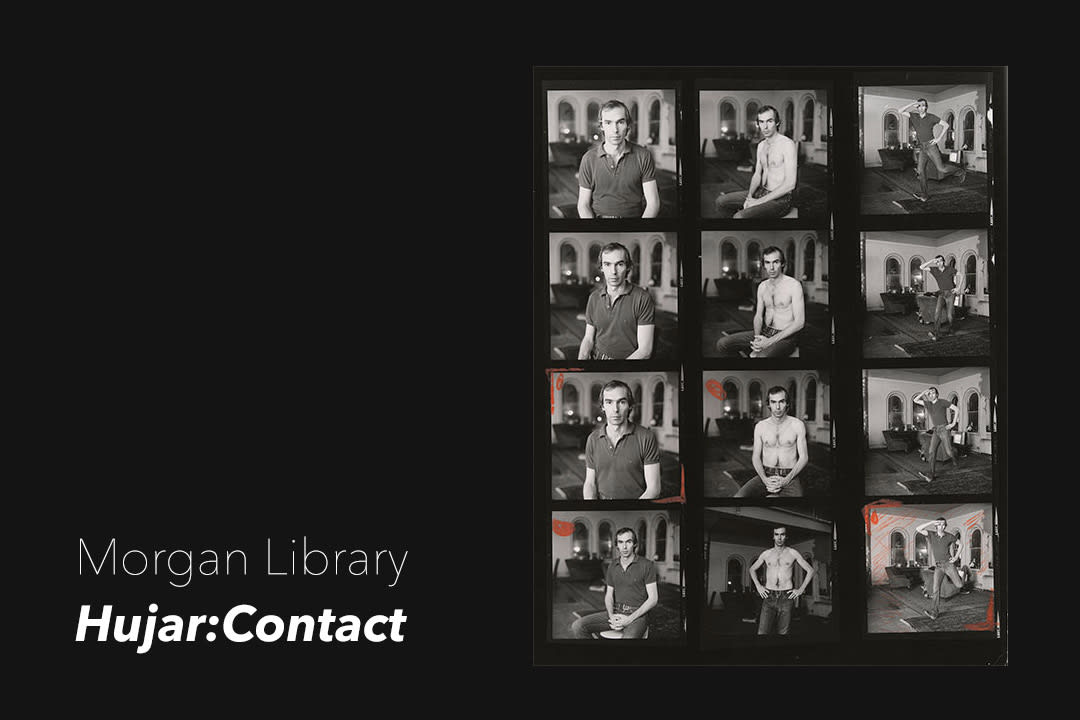
On May 22, the Morgan Library & Museum in New York opens Hujar:Contact — an exhibition offering something that has never been possible before: more than 110 of Peter Hujar’s original contact sheets and 20 enlargements, drawn from the Morgan’s extraordinary archive of over 5,700 contact sheets spanning his entire career from 1954 to 1987.
Hujar (1934–1987) photographed the overlapping worlds of artists, writers, drag performers, and underground luminaries in downtown New York. His portraits of Marsha P. Johnson, Candy Darling, Patti Smith, David Wojnarowicz, Susan Sontag, Fran Lebowitz, and Paul Thek are among the defining images of their era. He was largely ignored by the mainstream art world during his lifetime. He died of AIDS in November 1987, 53 years old. His work is now recognized as among the most significant American portrait photography of the 20th century.
Contact sheets show what a photographer chose — and what they didn’t. They reveal the editing mind at work, the frame before the decisive frame, the hesitations and instincts behind the work we know. The Morgan’s archive of Hujar’s contact sheets is one of the most significant photographic archives in America. Hujar:Contact is the first exhibition to make that archive public at this scale. The accompanying catalogue, co-published by MACK and the Morgan Library, with texts by Joel Smith, arrives the same day. On view through October 25, 2026.
WHY IT MATTERS
Throughout his career, Hujar recorded more than a thousand photo shoots in job books — handwritten logs of every session. Those books are transcribed and annotated in the catalogue, illuminating the contact sheets alongside never-before-seen images and the earliest iterations of his most iconic works. Hujar photographed people the art world passed over — and the art world spent 40 years catching up. This exhibition is the reckoning.
THE PHOTOGRAPH
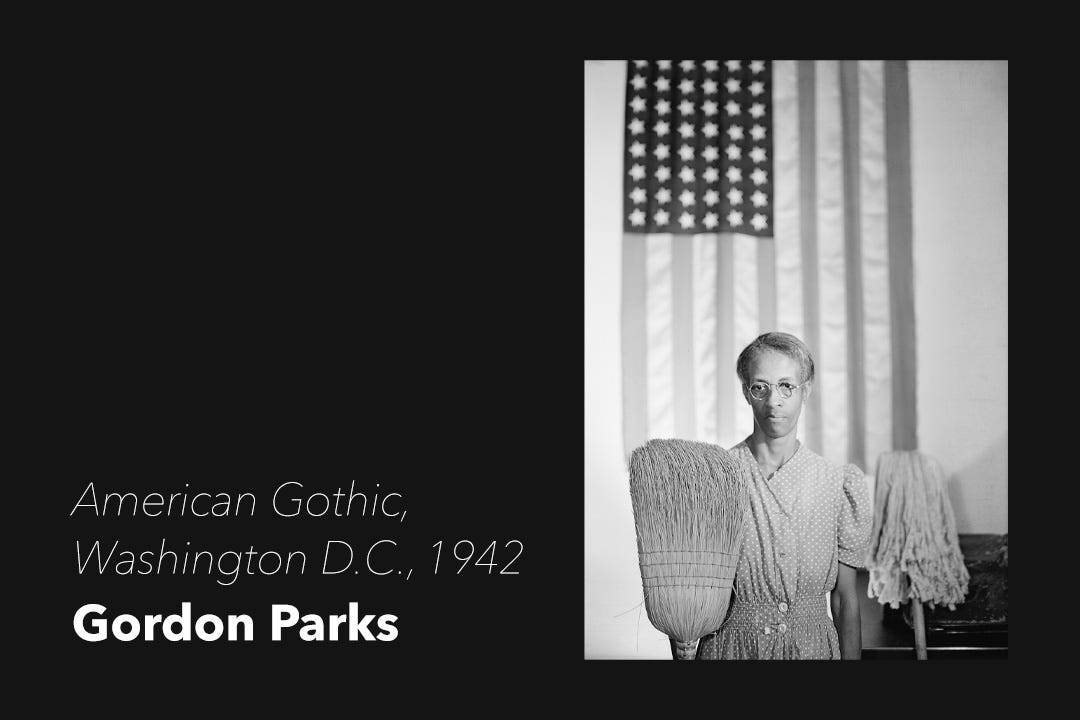
American Gothic, Washington D.C. — Gordon Parks, 1942
In 1942, Gordon Parks was a young photographer working for the Farm Security Administration in Washington, D.C. His supervisor, Roy Stryker, asked him to document the conditions facing Black Americans in the capital. Parks met Ella Watson, a government charwoman who cleaned the federal buildings at night for a wage that barely covered her rent. She had grown up in poverty, lost her husband and a daughter, and was raising a grandchild and an adopted daughter on her cleaning salary.
Parks placed Watson in front of an American flag — broom in one hand, mop in the other — and photographed her. The composition directly mirrors Grant Wood’s American Gothic (1930). Stryker saw the contact sheet and told Parks it was the greatest photograph he had ever seen — then quietly removed it from the FSA archive, fearing it too politically charged for the times. The image circulated anyway. When Parks joined LIFE magazine in 1948 as its first African American staff photographer, he brought American Gothic with him. It became one of the defining images of American documentary photography.
Parks later said Watson’s story represented “everything that was wrong with America.” The photograph is in the permanent collections of the Smithsonian American Art Museum, the Library of Congress, and dozens of other institutions worldwide. Watson herself appears in several other photographs Parks made that day — at church, at home, with her grandchildren — that were never suppressed. But it is American Gothic that history kept.
WHY IT MATTERS
The photograph holds two ideas at once: the promise of America and the reality of it, in the same frame. Parks did not need to editorialize. He simply put Ella Watson in front of the flag and pressed the shutter. The genius is in the restraint — the trust that the image, correctly composed, would say everything. Like Hujar, Parks photographed people who were routinely overlooked, with an attention that refused to simplify what it found. The subjects survived. The photographs outlasted almost everything else.
OFF THE PRESS
New & Noteworthy
Hujar:Contact by Joel Smith
MACK + The Morgan Library & Museum
364 pages • Flexicover with linen spine
The catalogue accompanying the Morgan Library’s landmark exhibition, arriving on the same day the show opens — May 22. Texts by Joel Smith establish a chronology of Hujar’s contact sheets from 1954 to 1987, presenting an artist developing and refining his practice against the tumultuous cultural politics of Stonewall and AIDS. Hujar’s handwritten job books — over a thousand entries — are transcribed and annotated throughout. Digital Camera World: “A love letter to the contact sheet, and what 5,700 of them reveal about one of photography’s most essential names.”
Holy Cow! by Melonie Bennett
GOST
176 pages • 66 images
Twenty years of family photographs made between 1990 and 2011 on a dairy farm in Maine — the rituals, dramas, laughter, gatherings, drunken exploits, and quieter moments of reprieve. Bennett grew up under constant financial stress but found her groove in the high school darkroom, becoming the designated driver at family parties so she could photograph what everyone else was doing. Intertwined with the images are recollections by her brother, Merritt. An unconventional family album, humane and funny, heavy and light at once.
Easy Days by Sage Sohier
Nazraeli Press
76 pages • 56 duotone plates
Made between 1978 and 1986, the 56 photographs in Easy Days capture the prosaic moments of ordinary people in the open spaces of parking lots, front yards, and public streets. This is the third title in Sohier’s trilogy, alongside Americans Seen and Passing Time, with an introductory interview by fellow Nazraeli alumnus Mark Steinmetz. Sohier’s work is in the permanent collections of MoMA, the San Francisco Museum of Modern Art, the Brooklyn Museum, and the Art Institute of Chicago. “These pictures describe a long-ago time, and yet in looking at them I become once again the young photographer who took them on a hot summer day.”


ON VIEW
New This Week
Photo London 2026
Olympia, Kensington, London
May 14 – 17, 2026
VIP Preview May 13
Photo London opens its first edition at Olympia this week — the most significant annual photography fair in the UK. Steven Meisel as Master of Photography; a dedicated Screening Room featuring Sarah Moon, Alys Tomlinson, and Luka Yuanyuan Yang; the Source Section curated by Tristan Lund; and a Talks Programme including conversations on truth, AI, and visual journalism.
Hujar:Contact
The Morgan Library & Museum | New York
May 22 – October 25, 2026
110+ contact sheets, 20 enlargements. See THE FRAME above. Catalogue published by MACK ships the same day.
Callahan, Gowin and Sommer
Etherton Gallery | Tucson
Through July 11, 2026
53 iconic, rare, and vintage photographs tracing a lineage: Gowin studied with Callahan, befriended Sommer. Together the backbone of American photographic modernism.
Mixedness Is My Mythology — Farren van Wyk
Fotomuseum Den Haag
Through August 23, 2026
South African-Dutch photographer Farren van Wyk examines the legacies of colonialism, migration, and apartheid through black-and-white portraiture, redefining her “coloured” classification and reclaiming her family’s heritage.
OPEN CALLS
Deadlines This Week
Arles Book Awards 2026 — Deadline May 13. No fee. Three categories: Author’s Book, Historical Book, Photo-Text Book. Prize: €6,000 per category, split between publisher and author. Eligible books published May 2025–May 2026.
Singapore International Photography Festival 2026 — Deadline May 17. Fee: €25–38. 10th biennial edition. Three prizes of SGD$2,000 each: Best Portfolio, Best Published Photobook, Best Dummy Photobook.
DATES & EXHIBITIONS
Openings, closings, and what’s on now
OPENING SOON
May 14–17: Photo London 2026 open to the public.
May 22: Hujar:Contact opens, The Morgan Library & Museum, New York (through Oct 25).
May 28–30: World Press Photo Days, Amsterdam. Public event The Stories That Matter on May 30.
CLOSING SOON
May 13: Deadline — Arles Book Awards 2026.
May 14: Last day — Ken Karagozian: Wilshire Subway — 1301PE, Miracle Mile, Los Angeles.
May 16: Last day — Outside Help (Christopher Richmond) — Moskowitz Bayse, Los Angeles.
May 17: Deadline — Singapore International Photography Festival open call.
May 17: Last day — KYOTOGRAPHIE — Kyoto.
May 24: Last day — Sophie Calle: Overshare — OCMA, Costa Mesa.
May 24: Last day — Johny Pitts: Black Bricolage — MEP, Paris.
May 31: Last day — Catherine Opie: To Be Seen — National Portrait Gallery, London.
May 31: Last day — Les Boutographies — Montpellier.
ONGOING
World Press Photo Exhibition — De Nieuwe Kerk, Amsterdam (through Sep 27).
Francesca Woodman — Gagosian, Rome (through Jul 31).
Fotografia Europea — Reggio Emilia (through Jun 14).
Mixedness Is My Mythology — Fotomuseum Den Haag (through Aug 23).
A Light Exists in Spring — Center for Photographic Art, Carmel (through Jun 23).
ONE QUESTION
Gordon Parks photographed Ella Watson in front of the American flag in 1942. His editor called it the most powerful image he’d ever seen — then pulled it from the archive, fearing it was too politically charged. Is there such a thing as too political for a photograph — or is that exactly when photographs matter most?
Tell us what you think in the comments. We’ll highlight the best responses next issue.
DID YOU KNOW?
Gordon Parks was the first African American photographer hired by LIFE Magazine, in 1948. He went on to work there for over 20 years, shooting fashion, crime, celebrity portraits, the civil rights movement, and the Black Panthers. In 1971, he directed Shaft — making him the first African American director to helm a major Hollywood studio picture. When he died in 2006 at 93, the New York Times described him as “one of the most versatile figures in American arts and letters.”
ON THIS DAY
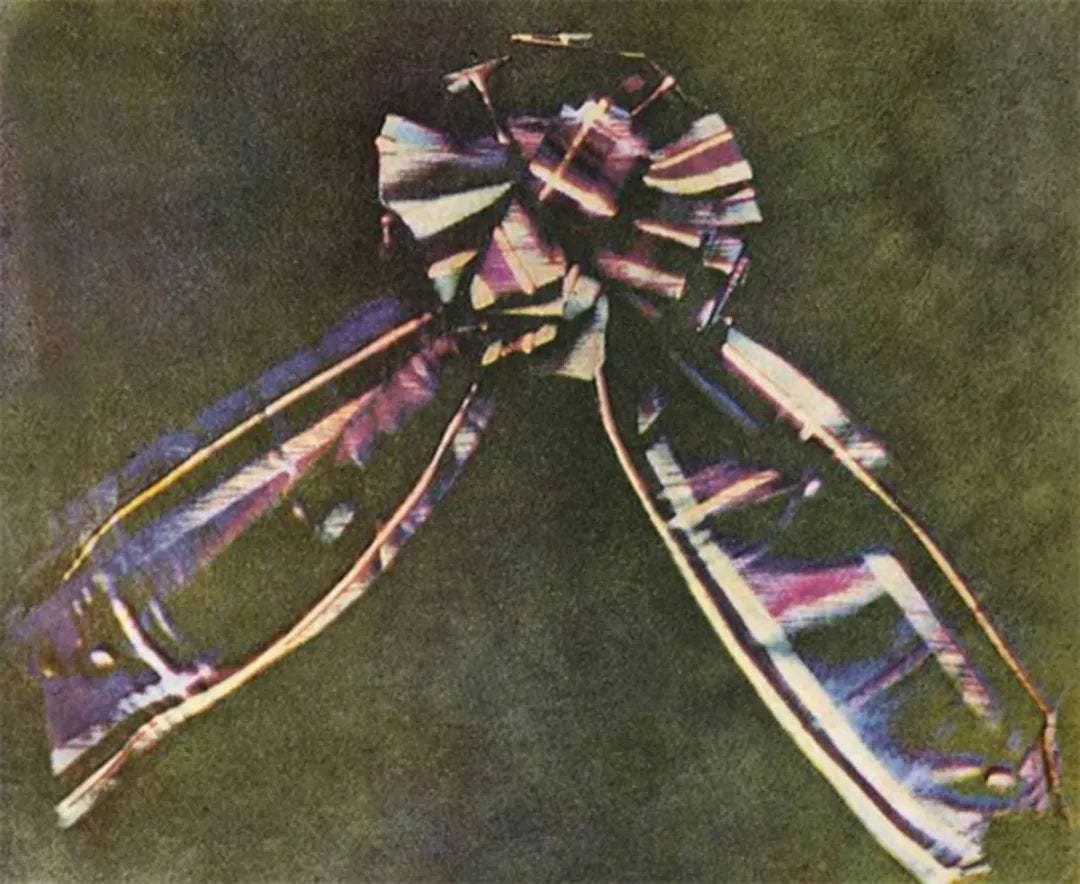
May 17, 1861: Scottish physicist James Clerk Maxwell delivered a lecture at the Royal Institution in London in which he demonstrated, for the first time in history, the principles of color photography. The image — a tartan ribbon — had been photographed three times by Thomas Sutton, inventor of the single-lens reflex camera, using red, green, and blue-violet filters. Three black-and-white glass plates were then projected through those same filters using separate lantern slides, creating a composite color image on a screen. Maxwell’s purpose was not to invent photography but to prove his theory of three-color vision: that all colors visible to the human eye can be created by combining red, green, and blue light. The demonstration proved the concept — imperfectly, as the photographic plates of the era were not sensitive to red light, and the “red” in the tartan image was captured partly through ultraviolet reflectance by accident. But the additive RGB color model Maxwell established that evening in 1861 is the foundation for every color photograph, every digital screen, and every camera sensor in existence today. The three original glass plate separations survive at the Cavendish Laboratory, Cambridge.

THE INTERNATIONAL REVIEW OF PHOTOGRAPHY
To advertise an exhibition, book, fair, or open call, email internationalphotographynews@gmail.com