

THE PHOTOGRAPH
“Behind the Gare Saint-Lazare” — Henri Cartier-Bresson, 1932
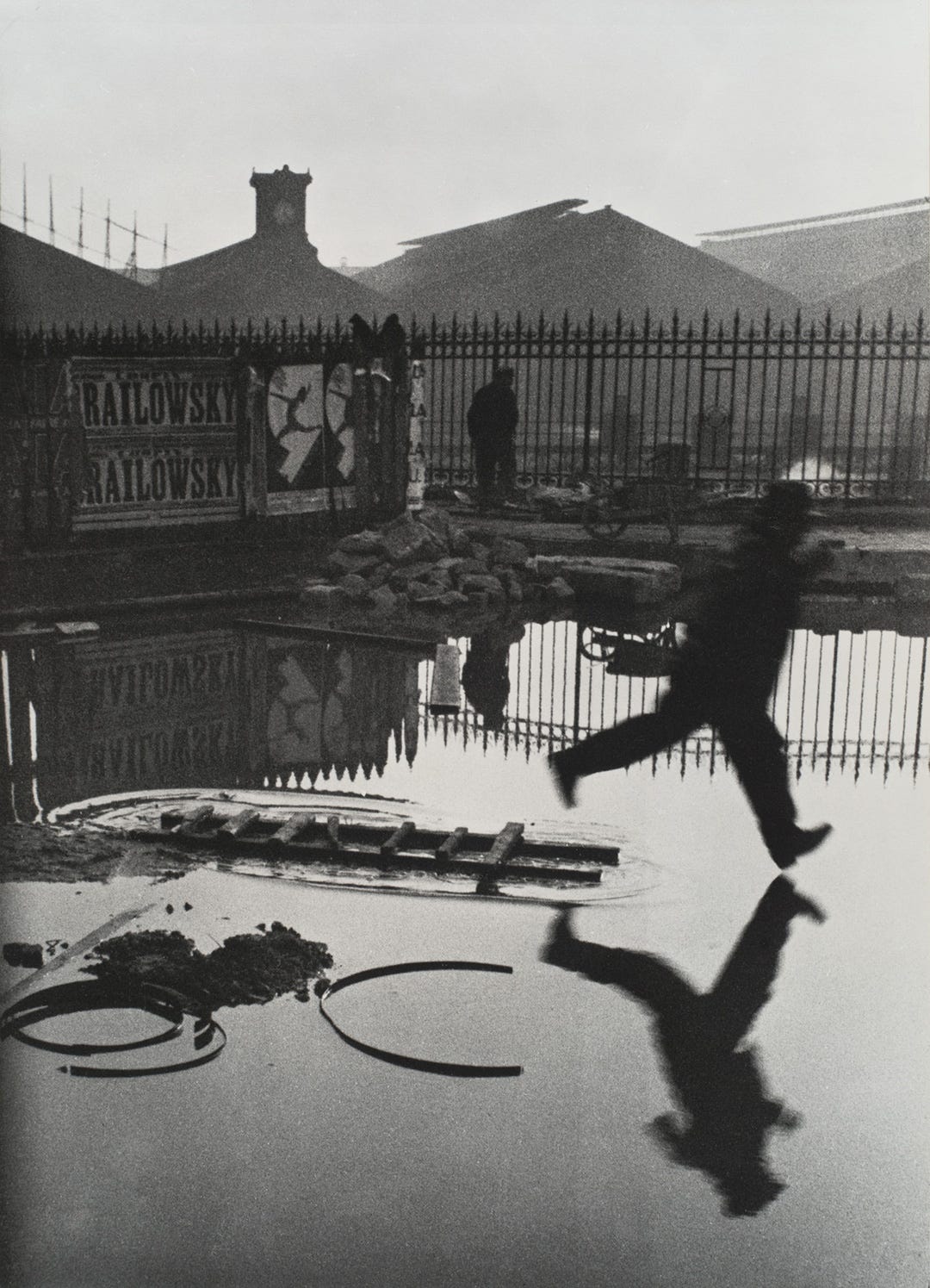
A man leaps across a flooded yard behind a Paris railway station, one foot about to break the surface, his whole body mirrored in the water below. He never lands. For almost a century he has hung there, suspended a few inches above his own reflection, in what is probably the most quoted single frame in the history of the medium. Cartier-Bresson made it in 1932, shooting blind through a gap in a fence behind the Gare Saint-Lazare, and it became the textbook illustration of the idea he spent the rest of his life preaching: the ‘decisive moment,’ the instant when form and event align and the photographer simply has to be ready to take it.
The picture entered the canon as proof that the great photograph is caught, not made — pure timing, nothing added, nothing removed. Time later named it to its list of the hundred most influential images ever taken.
There is one inconvenient detail. Cartier-Bresson cropped it. Shooting through the fence, he caught a vertical slat at the left edge, and the version the world knows was trimmed to remove it — an edit made after the shutter, in the darkroom, by the same man who told generations of photographers that cropping was a confession of failure, an admission you had not seen clearly enough in the first place. The most famous argument for getting it right in the camera is, in fact, a crop.
We raise this now not to take the icon down a peg but because the gap between what a photograph claims to be and what it actually is has rarely mattered more. We are living through the first moment when a “decisive moment” can be generated rather than witnessed — when a model can produce a man frozen above his reflection without a man, a puddle, or a camera ever existing. Cartier-Bresson’s leap reminds us that the seam between the caught and the constructed was never as clean as the legend wanted. He believed in the unrepeatable real. He also reached for the scissors.
WHY IT MATTERS
For more than 90 years Behind the Gare Saint-Lazare has carried the purest version of photography’s promise — that the camera reports rather than invents. The crop is a small, human reminder that even the medium’s strictest realist shaped his masterpiece after the fact. In 2026, as the distance between a photograph and a fabrication narrows to nothing, that is not a scandal but a useful inheritance: the decisive moment was always part discipline and part decision.
EXHIBITION HIGHLIGHTS
Alex Prager: Matinee
Lehmann Maupin · New York
On view through August 14, 2026
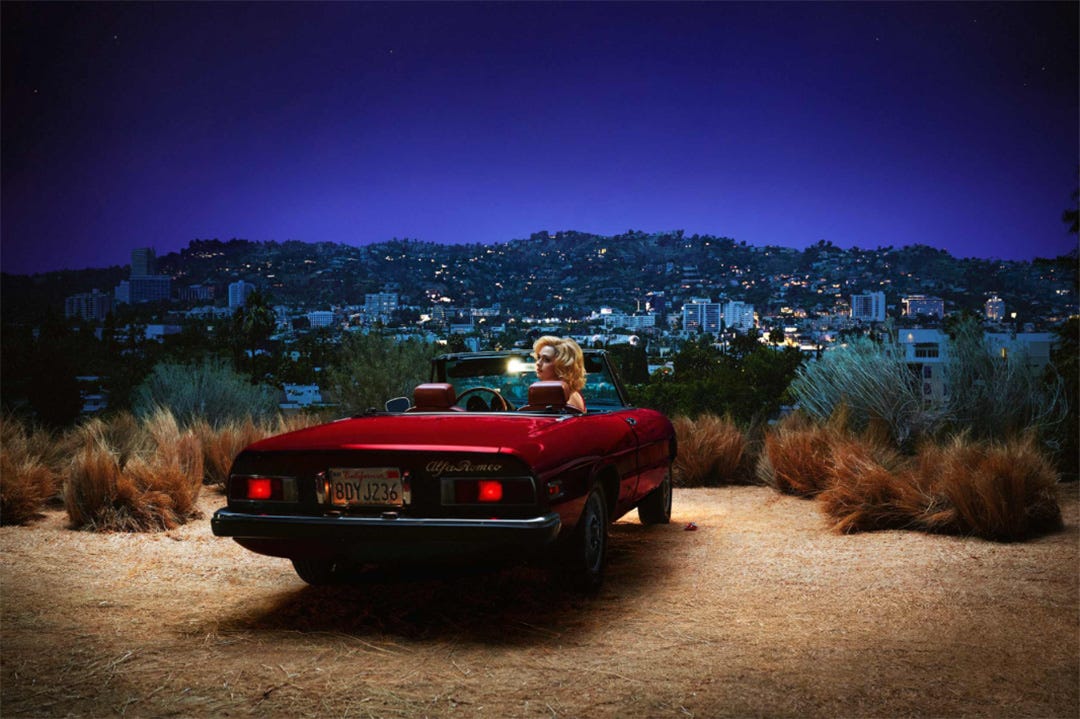
Prager returns with new large-format work that does in color and casting what Cindy Sherman did in black and white: stage a crowd, a mood, a frame that feels lifted from a film that does not exist. Her meticulously built scenes — every extra placed, every glance directed — read this season as a knowing counterpoint to the machine-made image, a reminder that the most convincing “candid” is often the most controlled.
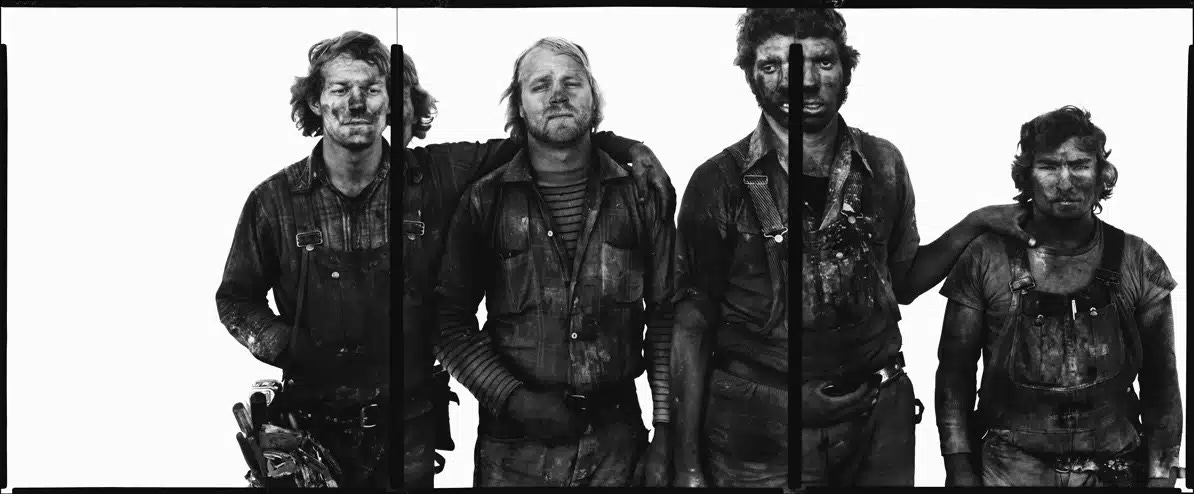
In the American West — Richard Avedon
Fundación MAPFRE · Madrid
On view through August 30, 2026
Avedon’s In the American West — the six-year project that sent the most celebrated fashion and portrait photographer of his era out to drifters, miners, waitresses, and slaughterhouse workers across thirteen states — gets a major museum survey in Madrid. Shot against plain white paper in unforgiving daylight, the series remains one of the most argued-over bodies of American portraiture: monumental and merciless in equal measure, depending on who is looking.
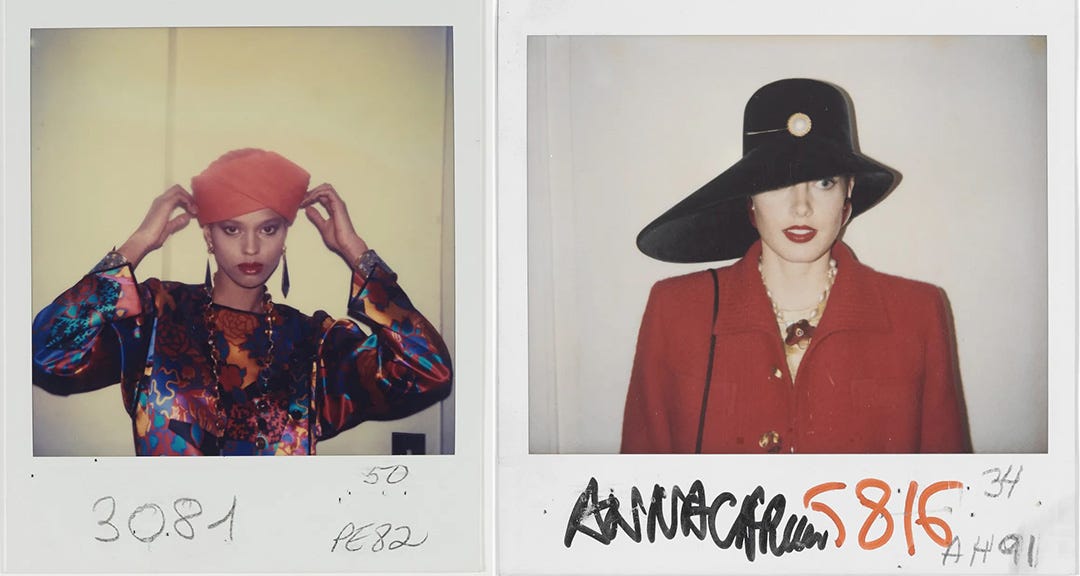
Yves Saint Laurent and Photography
International Center of Photography · New York
On view through September 28, 2026
The ICP turns its attention to a fashion house seen entirely through the lens, tracing how Yves Saint Laurent’s image was built and rebuilt by the photographers who shot the clothes, the runway, and the man himself. It anchors an unusually strong fashion-photography week in New York, alongside the Lillian Bassman selling show and the Avedon “Marilyn” lot heading to auction.
Marilyn Monroe: A Portrait
National Portrait Gallery · London
On view through September 6, 2026
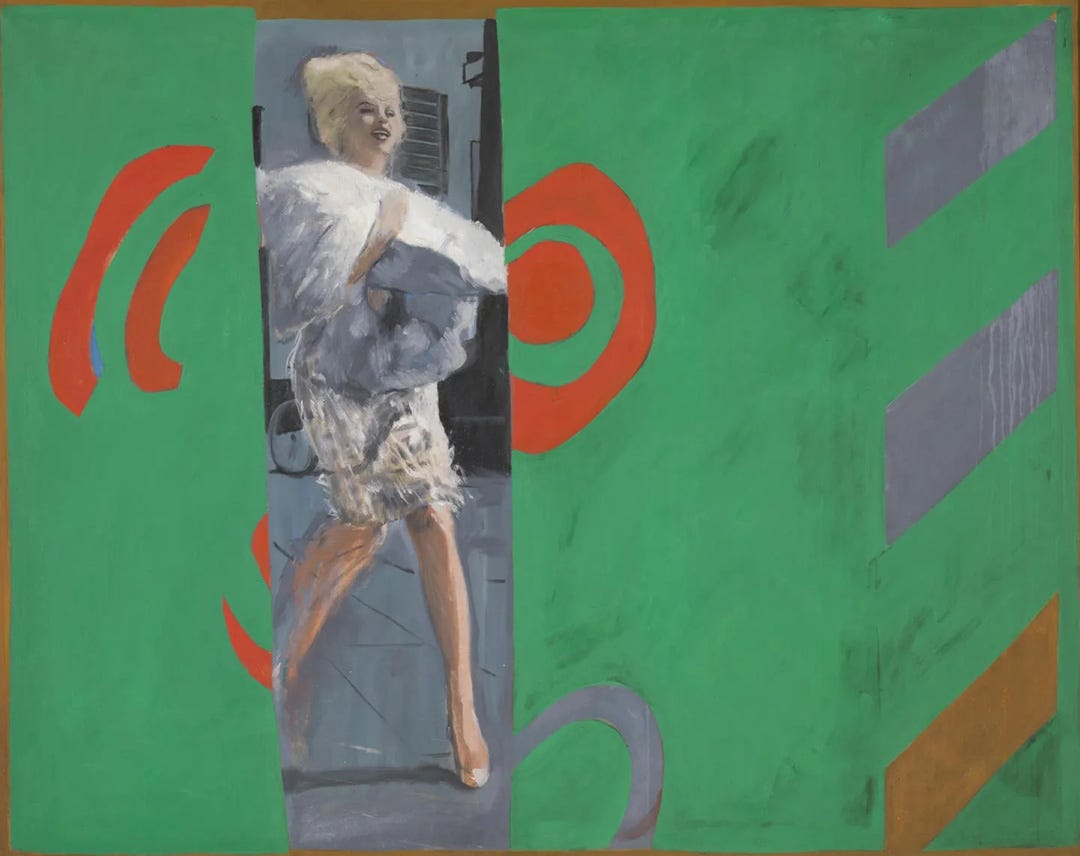
Marking the centenary of her birth, the National Portrait Gallery gathers the photographers who made and remade Monroe’s face — from press shots to studio sittings — and asks how much of the most photographed woman of the twentieth century was ever hers to control. The show lands the same month a single Avedon portrait of her goes under the hammer in London.
MORE ON VIEW
Opening Soon
Berlin
Walter Schels: The Lure of the Image — C/O Berlin · Opens Jun 19 (retrospective)
Amsterdam
Ed van der Elsken: Up Close — Rijksmuseum · Opens Jun 19 (retrospective)
Barcelona
Minor White — KBR Photography Center / Fundación MAPFRE · Opens Jun 18
Eloquent Form — Joaquín Tusquets de Cabirol — KBR Photography Center / Fundación MAPFRE · Opens Jun 18
London
Japanese Women Photographers: From 1950s to Now — The Photographers’ Gallery · Opens Jun 24
NINAGAWA Mika: Captive Blooms — The Photographers’ Gallery · Opens Jun 24
New York
An American Beauty: Grateful Dead 1965–1995 — David Kordansky · Opens Jun 23
Frank Paulin: Unseen Color, 1956–2008 — Bruce Silverstein · Opens Jun 26
Lausanne / Winterthur
Hannah Darabi: Why Don’t You Dance? — Photo Elysée · Opens Jun 26 (documentary)
Shadow Creatures: From Spirit Photography to the Ghosts of the Algorithm — Fotomuseum Winterthur · Opens Jun 26 (AI / historical)
Closing Soon
Paris
Nan Goldin: This Will Not End Well — Grand Palais · Closes Jun 21 (retrospective)
Winterthur
Paul Mpagi Sepuya: Focus. Desire — Fotomuseum Winterthur · Closes Jun 26 (portraiture)
Ongoing
A rotating selection of shows worth the trip, beyond the openings and closings above.
Paris
Lee Miller — Musée d’Art Moderne de Paris · Through Aug 2
Camille Vivier — Maison Européenne de la Photographie · Through Sep 13
Winnie Mo Rielly — MEP Studio · Through Jul 12
République — Bérangère Fromont — Delpire & Co · Through Aug 28
Amsterdam
World Press Photo 2026 — De Nieuwe Kerk · Through Sep 27 (photojournalism)
Hamburg
Alliance, Infinity, Love — In the Face of the Other — Haus der Photographie / Deichtorhallen, Hamburg · Through Sep 22
Vienna
Katherine Hubbard: The Great Room — Wiener Secession, Vienna · Through Aug 30
New York
Hujar:Contact — The Morgan Library & Museum · Through Oct 25 (historical)
Photobooks USA 2000–25 — International Center of Photography, New York · Through Sep 28
Lillian Bassman: Elegance in Light — Sotheby’s, New York · Through Jul 31 (selling exhibition)
Bob Mizer: Athletic Model Guild Catalog Boards, 1945–55 — Daniel Cooney Fine Art, New York · Through Jul 25
Virginia
Ilse Bing: Between Paris and New York — Chrysler Museum of Art, Norfolk VA · Through Oct 18
Fort Worth
Black Photojournalism — Amon Carter Museum · Through Jul 5 (photojournalism)
San Francisco
Feel the Beat: Dance in Photographs — SFMOMA · Through Jan 31, 2027
Los Angeles
Marilyn Monroe: A Silent Life — Peter Fetterman Gallery · Through summer 2026
Daido Moriyama: The Hunter — Peter Fetterman Gallery · Through summer 2026
A Simple Game — Marshall Gallery, Santa Monica · Through Jul 18 (World Cup group show)
Double Take: Photographs in Pairs — Fahey/Klein Gallery, Los Angeles · Through Jul 18
Catherine Opie: Holding Blue — Regen Projects · Through summer 2026 (fine art)
Japan
Unprecedented: Women Photographers from the GDR — Museum of Modern Art, Hayama (Japan) · Through Aug 30
FAIR & FESTIVAL WATCH
Les Rencontres d’Arles 2026 — Arles · opening week July 6–12, runs through October 4 (the anchor of the European photography summer — a forward look)
photo basel — Basel · June 16–21 (Art Basel week)
Fotofestiwal Łódź — Łódź · June 18–28 (25th edition)
GU.PHO 2026 — Guiglia, Italy · June 18–26
ZeroNegativo 2026 — Santeramo in Colle · June 18–21
Copenhagen Photo Festival 2026 — Copenhagen · through June 21
Athens Photo Festival 2026 — Athens · ongoing
PHotoESPAÑA 2026 — Madrid · through September 13
OPEN CALLS
International Photography Awards (IPA) 2026 — international photography competition · Final deadline June 30
LensCulture Street Photography Awards 2026 — street photography competition · Deadline June 17
OFF THE PRESS


Shine Brightly: Korean Photography Since 1957
by Sunyoung Kim & Holly Roussell
Thames & Hudson
356 pages, hardcover
The first comprehensive English-language survey of Korean photography, Shine Brightly gathers more than sixty photographers and over 250 images to trace the medium from its post-war documentary roots to a contemporary scene now central to the global art world. Newly published internationally — the US hardcover follows in December — it lands the same week London previews two major Japanese photography surveys, part of a broad turn toward East Asian photographic history.
Mango Season by Jenia Fridlyand
Steidl
May 2026 · 112 pages, hardcover with a tipped-in silver gelatin print
Jenia Fridlyand grew up in the Soviet Union in the years just before perestroika, and when she traveled to Cuba decades later the visit felt, she has said, like an uncanny homecoming — the familiar grain of communist daily life unraveling under a bright tropical sun. Working with a large-format camera in the American documentary tradition, she trained her lens on moments that hold both the known and the novel: donkeys silhouetted on a hilltop, a barber’s customer, sweat on a curved back, fruit ripening in a doorway. Co-published with The Agency in the Hudson Valley, it is a quiet, exacting book about how a place can be at once foreign and remembered.
Secrets: Aperture No. 263, Summer 2026
Aperture
Aperture’s summer issue takes “Secrets” as its theme — the concealed, the withheld, the deliberately unseen — at a moment when photography’s relationship to truth is being renegotiated in public. It is a timely companion to a season preoccupied with who controls an image and what a picture is allowed to hide, threading contemporary portfolios through an idea as old as the camera itself: that every photograph keeps something out of frame.
DID YOU KNOW?
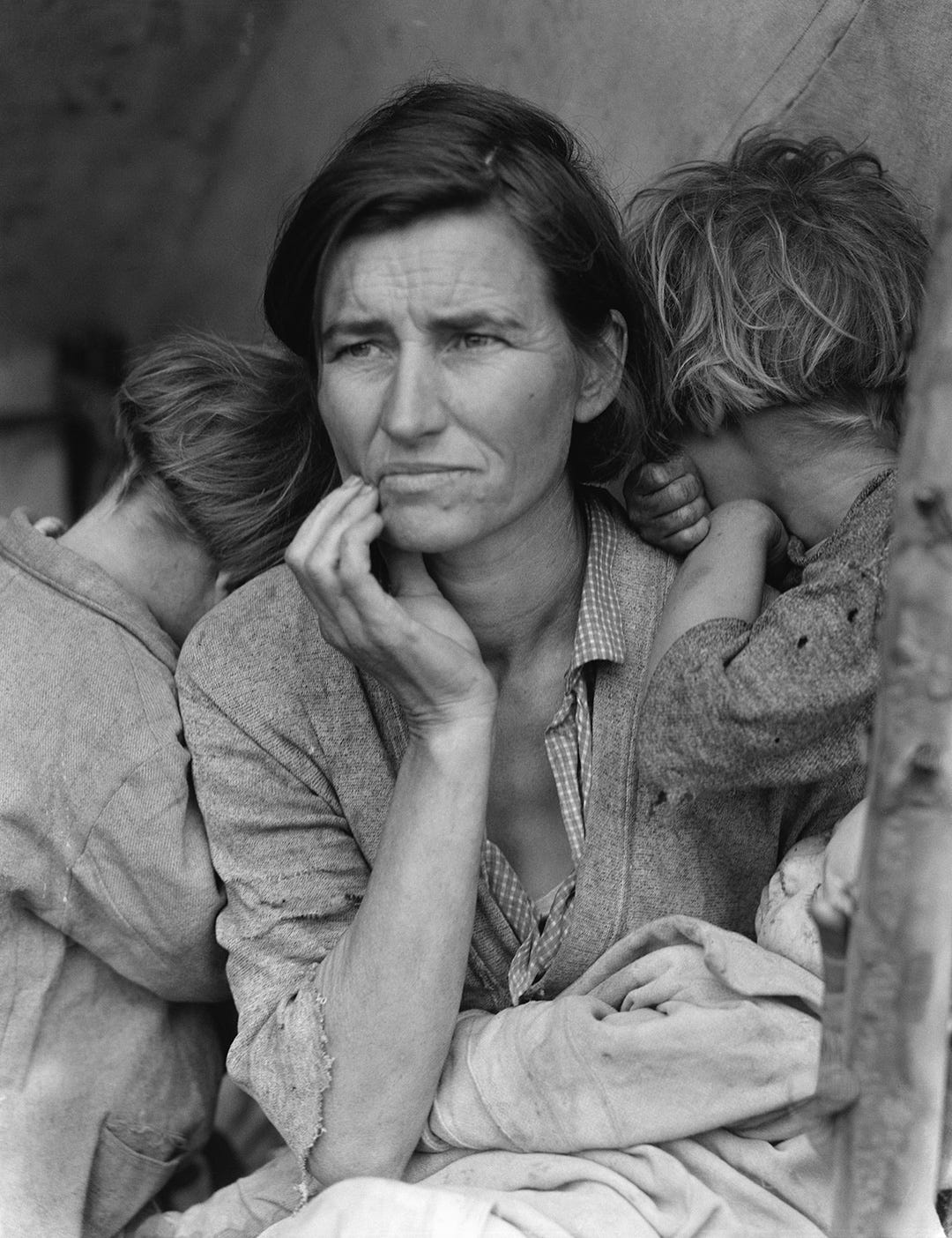
The most reproduced photograph of the Great Depression earned its maker nothing — and its subject less. Dorothea Lange shot Migrant Mother in 1936 while on the federal payroll of the Farm Security Administration, which meant the image entered the public domain the moment it was made. It has been printed, parodied, and repurposed ever since, and neither Lange nor Florence Owens Thompson, the woman in the picture, ever received a cent in royalties.
Thompson, who said she felt the photograph had been taken without her consent, spent decades watching her own face become a national symbol she did not own. Thompson later expressed that she regretted having her picture taken. In a 1978 interview with the Los Angeles Times, she stated that Lange did not ask for her name, promised the images would not be sold, and never sent her a copy. However, Thompson's family also noted that at the time, she allowed the photos because she hoped they would show the severity of the times and bring aid to starving migrant workers.
It is a useful thing to remember now, as a new generation of image-making machines is trained on exactly such freely available pictures.

THE INTERNATIONAL REVIEW OF PHOTOGRAPHY
To advertise an exhibition, book, fair, or open call to photography collectors, curators, and gallerists worldwide, email internationalphotographynews@gmail.com