

THE FRAME
In a Democracy, the Camera’s Presence in That Hallway Was Not Incidental. It Was Essential.
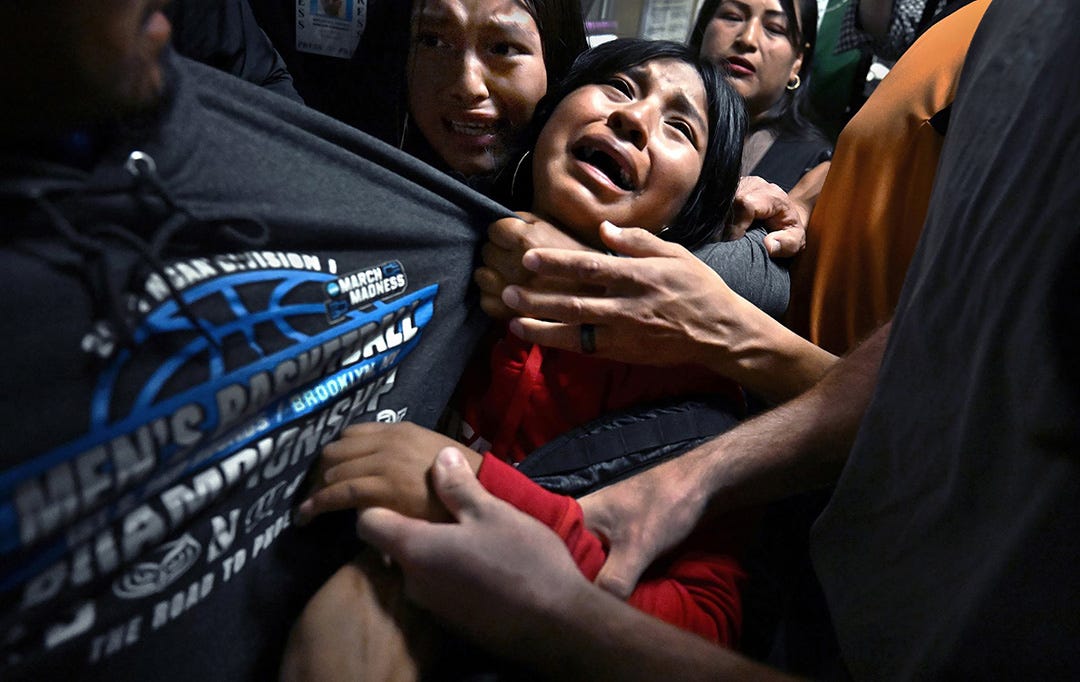
The 2026 World Press Photo of the Year was announced on April 23. The winning image was made by Carol Guzy of ZUMA Press and the Miami Herald on August 26, 2025, at the Jacob K. Javits Federal Building in New York City — one of the very few US federal courthouses where photographers had been granted access. It shows Luis, an Ecuadorian migrant with no criminal record and the sole financial provider for his family, being detained by ICE agents following a routine immigration court hearing. In the hallway behind him, his wife Cocha and their three children — ages 7, 13, and 15 — are left inconsolable.
The jury’s statement was precise and unambiguous: “What Guzy records here is not an isolated moment of grief, rather, it is evidence and documentation of a government policy being applied systematically to people who followed the rules they were given. In a democracy, the camera’s presence in that hallway is not incidental, it is essential.”
Two photographs were named finalist. Saber Nuraldin of EPA Images photographed Palestinians climbing onto an aid truck entering Gaza via the Zikim Crossing during a brief suspension in Israeli military operations — a single image the jury said “offers visual evidence of famine.” And Victor J. Blue, photographing for the New York Times Magazine, documented Maya Achi women outside a Guatemala City court on the day three former civil defense patrollers were sentenced to 40 years in prison for rape and crimes against humanity — the conclusion of a 14-year legal battle begun when 36 Indigenous women broke their silence in 2011. The jury noted Blue’s “classical, restrained approach emphasizes the women’s dignity and authority, deliberately countering historical visual narratives that frame women—particularly survivors of sexual violence—as powerless subjects.”
Selected from 57,376 entries across 141 countries. The exhibition opens April 24 at De Nieuwe Kerk in Amsterdam and travels worldwide through 2027. World Press Photo
WHY IT MATTERS
Carol Guzy has now won the Pulitzer Prize for Photography four times — 1991, 1995, 2000, and 2011 — more than any photographer in history. She is 69 years old. She began her career as a nurse before switching to photography at 25. The photograph of Luis and his family is not a photograph about immigration as an abstract policy debate. It is a photograph of a specific man, a specific family, and a specific hallway. That specificity is what makes it a great photograph. And that specificity is why the camera needed to be there.
ON VIEW
New This Week
Lillian Bassman: Bazaar and Beyond
Metropolitan Museum of Art, New York
Through July 26, 2026
Lillian Bassman was the art director at Harper’s Bazaar who championed and promoted Richard Avedon, Robert Frank, and Paul Himmel before becoming a landmark photographer in her own right. Her high-contrast black-and-white images of women — defined by gesture, silhouette, and abstraction rather than literal representation — challenged the conventions of fashion photography between the 1940s and 1960s. Rare vintage prints, layout designs, and darkroom experiments on view. Bassman once said her contribution to the genre “has been to photograph fashion with a woman’s eye for a woman’s intimate feelings.”
Nhu Xuan Hua: Of Walking on Fire
Autograph, London
April 16 – September 19, 2026
Surreal, imaginative portraiture that probes the limits of communication and memory. Nhu Xuan Hua’s parents immigrated to France from Vietnam; her work restages scenes from archival images, obscuring faces and identities with garments, flashes of light, and digital manipulation. The body exists between eras and places — suspended in displacement, resisting resolution. Previously shown at Huis Marseille, Amsterdam and Les Rencontres d’Arles.
New Woman, New Vision: Women Photographers of the Bauhaus
Bauhaus Archiv, Berlin
April 17 – October 4, 2026
Works by Gertrud Arndt, Marianne Brandt, Grit Kallin-Fischer, and Lucia Moholy, among many others — photographers who used the medium as one of the few accessible pathways through the Bauhaus’s patriarchal structure. Their experimental methods were central to the New Vision movement and captured the contradictions of Weimar modernity: between craft and industry, emotion and function, the collective and the individual.
Deborah Turbeville: Photocollage
Moderna Museet, Malmö
May 2 – September 27, 2026
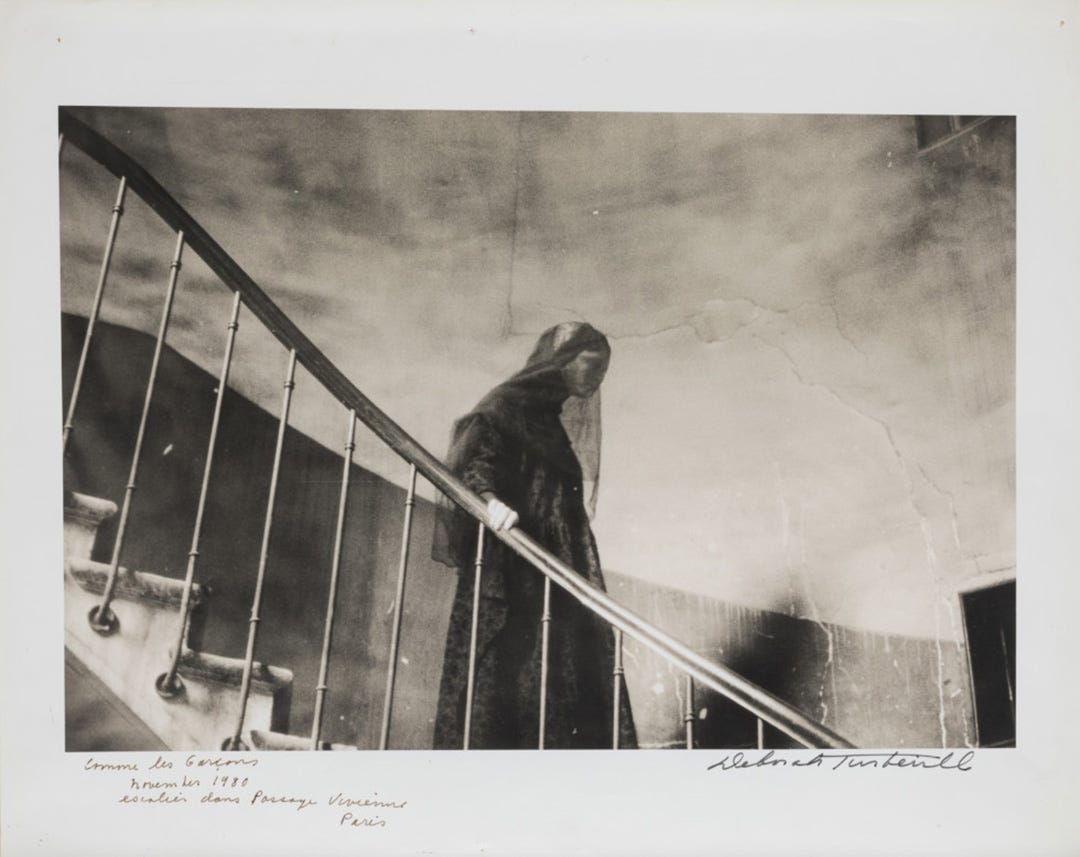
The great iconoclast of 1970s fashion photography alongside Guy Bourdin and Helmut Newton, concentrated here on her personal photocollage experiments: xeroxing, cutting, blurring, scratching, and pinning prints to heighten an air of unreality where fashion and fiction coalesce. Turbeville rejected the glossy sex appeal of the era and replaced it with something stranger and more unsettling.
Johny Pitts: Black Bricolage
MEP, Paris
Through May 24, 2026
Twenty years of documenting the African diaspora in Europe — London, Lisbon, Brussels, Berlin. “Being Black in Europe didn’t necessarily mean being an immigrant.” Pitts assembles photographic archives, ephemera, and personal testimony into an Afropean identity that is, in his words, “whole and unhyphenated.”
Francesca Woodman: Lately I Find a Sliver of Mirror Is Simply to Slice an Eyelid
Gagosian, Rome
April 29 – July 31, 2026
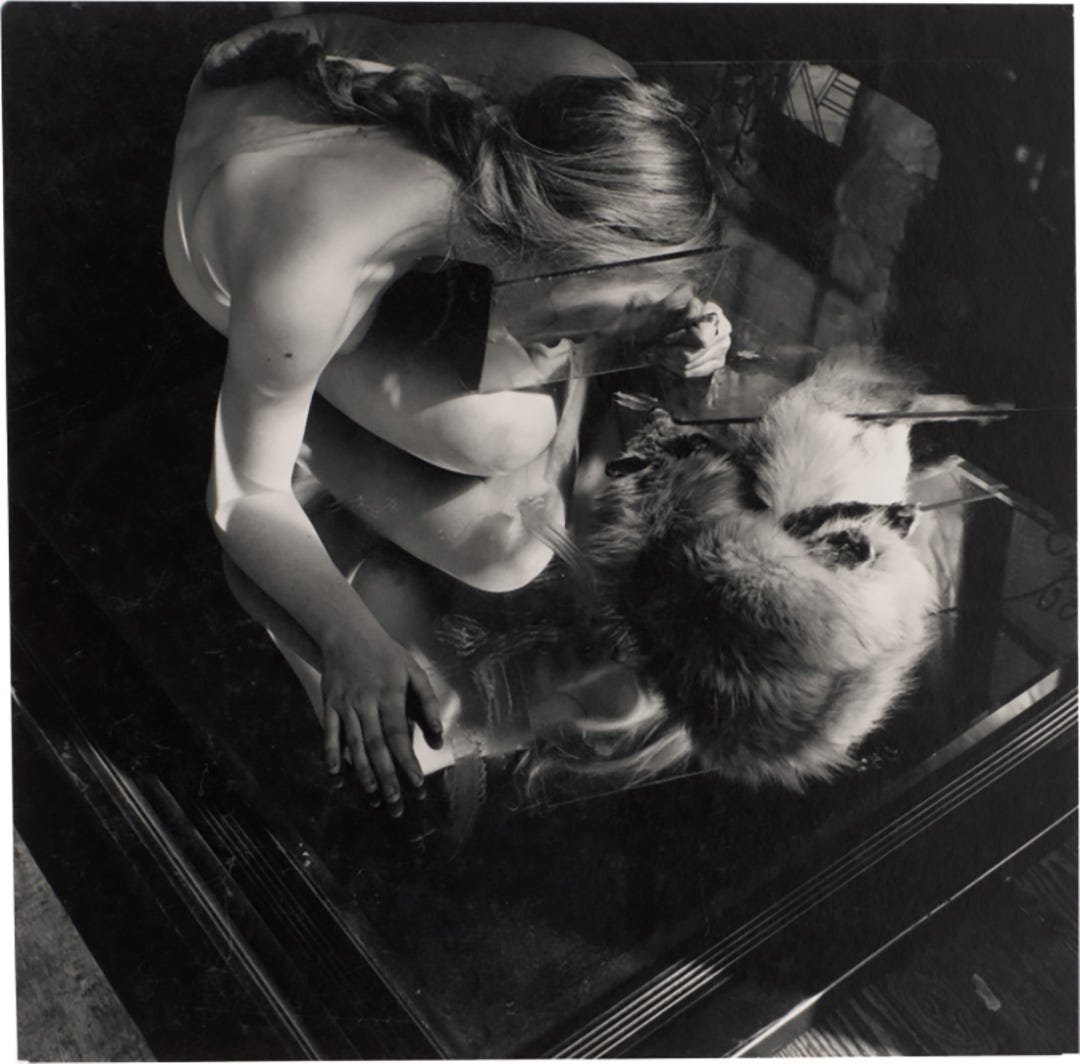
The exhibition centers on Woodman’s preoccupation with classical themes and archetypes — the body as sculpture, allegory as photographic language. Woodman photographed from 1972 until her death in 1981 at age 22, producing a body of work of extraordinary formal invention: blurred self-portraits, bodies merging with architecture, figures partially obscured by wallpaper and furniture. Her work was largely unknown during her lifetime and has since been recognized as one of the most original photographic projects of the late 20th century. Presented in Rome, the exhibition draws on the city’s deep connection to classical mythology and the ruins she inhabited as a student. An accompanying conversation features Brooke Holmes (Princeton, Classics) and representatives of the Woodman Family Foundation.
Anton Roland Laub: Mobile Churches in Ceaușescu’s Bucharest
The Wende Museum, Culver City, California
April 25 – October 11, 2026
A documentary project combining recent photographs with archival material to reveal a remarkable episode in Cold War urbanism: seven Orthodox churches in Bucharest secretly relocated — some moved at night — to conceal them behind Communist-era apartment blocks during Ceaușescu’s forced redevelopment of the Romanian capital. Architecture, religion, and state power seen through the documentary lens.
CLOSING SOON…
May 4: Eugène Atget: The Making of a Reputation — ICP, New York.
May 4: Sony World Photography Awards Exhibition — Somerset House, London.
ONGOING…
May 16: Outside Help (Christopher Richmond) — Moskowitz Bayse, Los Angeles.
May 24: Sophie Calle: Overshare — OCMA, Costa Mesa.
May 31: Catherine Opie: To Be Seen — National Portrait Gallery, London.
FAIR & FESTIVAL WATCH
Opening This Week
Fotografia Europea
Reggio Emilia, Italy
April 30 – June 14, 2026
Opens this Thursday
21st edition. Theme: Ghosts of the Moment. City-wide exhibitions, portfolio reviews, screenings, and workshops across Reggio Emilia.
Bieler Fototage
Biel/Bienne, Switzerland
May 9 – 31, 2026
Theme: vulnerability as a social and political condition. Exhibiting artists include Rafał Milach and Dominic Nahr, among others.
Photo London 2026
May 13 – 17, 2026
First year at its new Olympia venue. Master of Photography: Steven Meisel — the American fashion photographer who has produced an extraordinary volume of Vogue covers and collaborated with Madonna on Sex rarely exhibits publicly. For Photo London he presents images from his first professional assignment in London: portraits of Stella Tennant, Plum Sykes, Bella Freud, Honor Fraser, and Lady Louise Campbell, shot with stylist Isabella Blow. There is also a new “Source” sector curated by Tristan Lund with strong South Asian and Latin American representation.
KYOTOGRAPHIE
Kyoto, Japan
Through May 17, 2026
Anchored by a major Daido Moriyama retrospective spanning almost sixty years. Also: Ernest Cole, Pieter Hugo, Lebohang Kganye, Thandiwe Muriu, and work honoring Fatma Hassona, the Palestinian photographer-activist killed in Gaza in April 2025. Closing in three weeks.
IN FOCUS
Identical Twins, Roselle, N.J. —
Diane Arbus, 1967
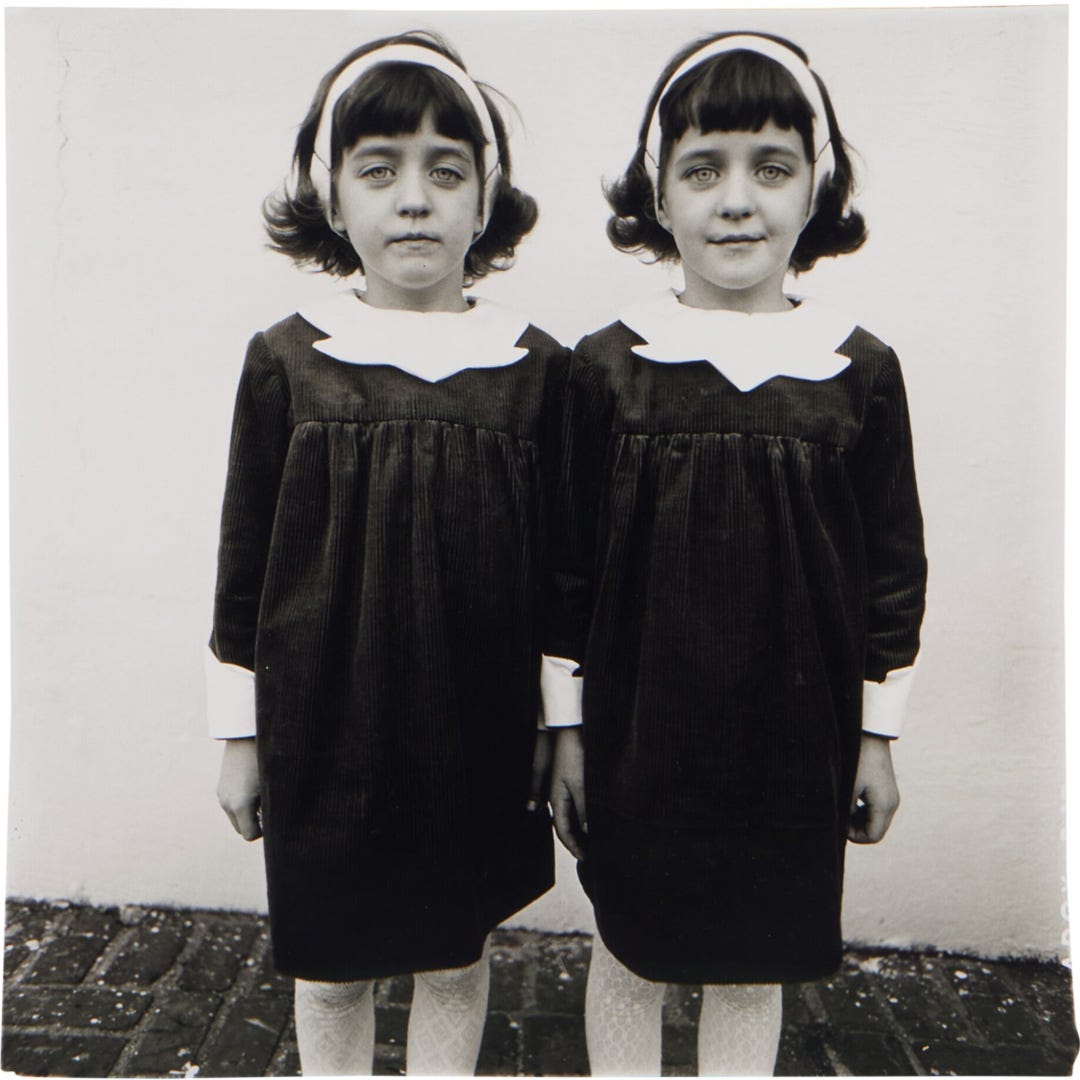
In December 1967, Diane Arbus attended a Christmas party for twins and multiples in Roselle, New Jersey. Among the children there were two sisters — Cathleen and Colleen Wade, seven years old — wearing matching dresses, matching bows, matching expressions, almost. Arbus photographed them head-on. One girl faces the camera with a cautious, slightly formal gaze. The other has a look of mild discomfort, a shadow across her face that the other doesn’t share. The dresses are identical. The children are not.
The photograph has been reproduced so many times and in so many contexts that it is now lodged in the visual unconscious of anyone who has paid attention to photography. Stanley Kubrick used it as the visual inspiration for the ghost twins in The Shining. It appeared this spring at Sotheby’s with an estimate of $70,000–100,000. It is held in the collections of MoMA, the Metropolitan Museum of Art, the San Francisco Museum of Modern Art, and dozens of other institutions worldwide. It is, by almost any measure, one of the ten most recognized photographs of the 20th century.
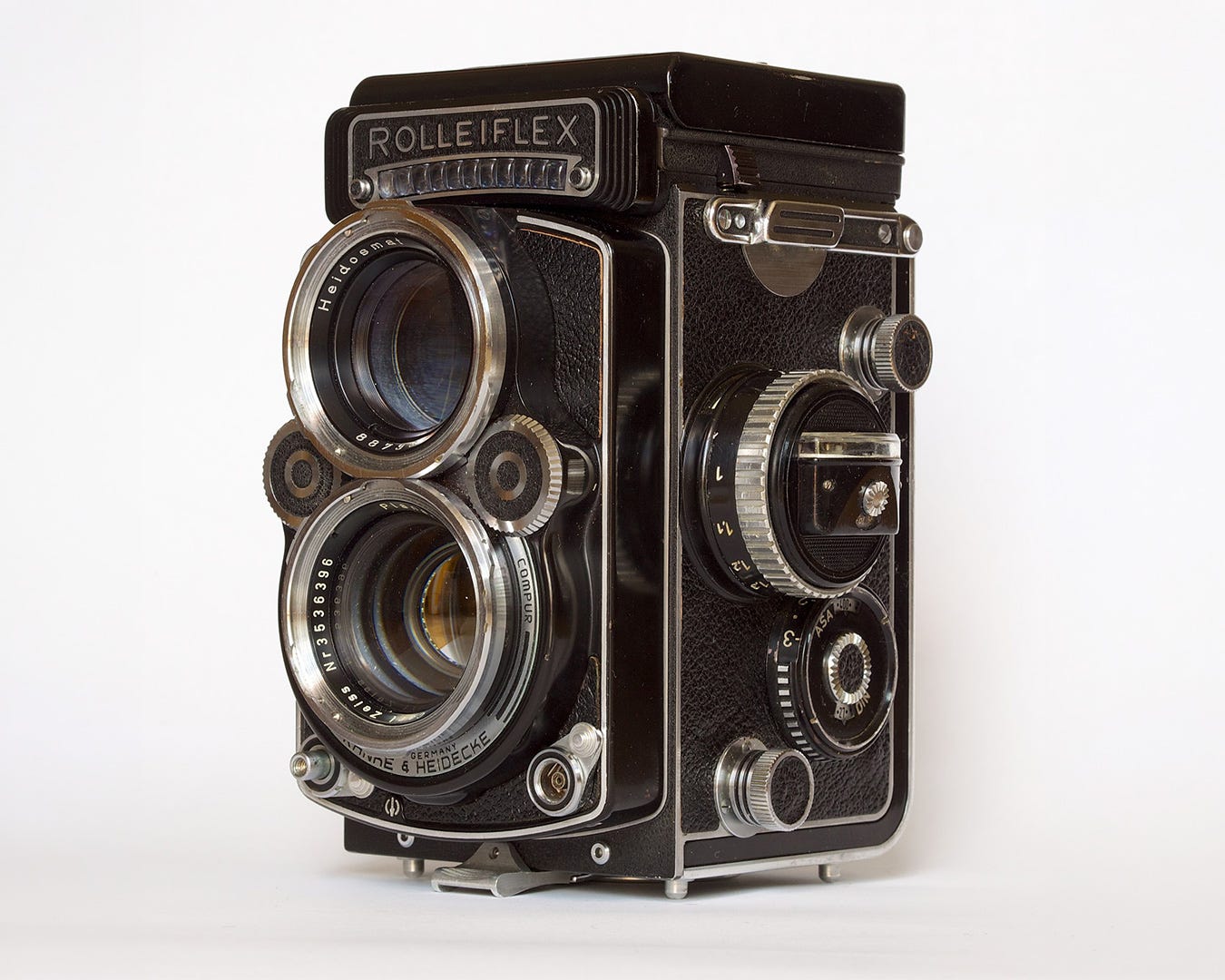
Arbus made it with a twin-lens reflex camera, looking down through the viewfinder — which gave her a different relationship to her subjects than a camera held to the eye. She is below them, slightly. They look down into the lens. The power dynamics are ambiguous in a way that feels deliberate. Arbus had been photographing people on the margins of mainstream American life since the late 1950s — nudists, transvestites, circus performers, the developmentally disabled — with an attention that was neither condescending nor voyeuristic but somehow both intimate and estranging. She died in 1971 at 48. This photograph was made three years before her death.
WHY IT MATTERS
The photograph presents a paradox at the center of Arbus’s entire project: two people who appear to be the same, shown at the moment that reveals they are not. Her work is consistently described as “disturbing” — but what disturbs is not the subjects. What disturbs is the quality of attention. She looked at people who were routinely not looked at, and she looked at them for a long time, and she printed what she found. The Roselle twins are a case study in how a single image can carry the weight of an entire philosophy of seeing.
OFF THE PRESS
New & Noteworthy
Sangre Blanca by Mads Nissen
GOST
May 2026
A decade in the making, Sangre Blanca (White Blood) is the most comprehensive photojournalistic exploration of the global cocaine industry ever published — tracing the supply chain from Colombian fields through processing, trafficking networks, distribution, addiction, and the violence and corruption that pervade every link in the chain. Nissen’s access is remarkable, his photographs unflinching. A book that connects a globalized industry to its human consequences at every scale.
Oslo Arkiv by Ole John Aandal
MACK
April 2026 · Limited edition of 750, signed
For a decade following the July 22, 2011 bombing by right-wing extremist Anders Behring Breivik, Aandal photographed the view overlooking Oslo’s Government Quarter — the administrative heart of Norway, which bore the brunt of the attack. The photographs trace how a city learns to look at a place that has been broken: scaffolding, demolition, new construction, the slow erasure of the wound. A study in collective memory and the urban landscape of loss. Available in signed and unsigned editions.
Song of Silent Water by Mathieu Chaze
L’Artiere
Preorder, ships May
A poetic meditation on nature born from walking — rolling hills, trees reflected in still water, solitary herons. Chaze’s photographs pursue sincerity over style, expressing the artist’s presence in a landscape without imposing on it. Preordered copies are signed by the artist.


OPEN CALLS
Deadlines This Month
Inge Morath Award 2026 — Deadline to apply is this Thursday, April 30. No fee. $7,500 from the Magnum Foundation for women and nonbinary photographers under 30. Last chance to apply.
IN THE WEEKS AHEAD
Key Dates: Through April 30
Apr 30: Deadline — Inge Morath Award (final chance).
Apr 30: Fotografia Europea opens, Reggio Emilia (through Jun 14).
May 2: Deborah Turbeville: Photocollage opens, Moderna Museet, Malmö (through Sep 27).
May 4: Last day — Eugène Atget: The Making of a Reputation, ICP, New York.
May 4: Sony World Photography Awards Exhibition, Somerset House, London.
May 9: Bieler Fototage opens, Biel/Bienne (through May 31).
May 13 – 17: Photo London 2026 at Olympia.
May 17: Last day — KYOTOGRAPHIE, Kyoto.
ONE QUESTION
The World Press Photo of the Year was made in a federal courthouse — one of the only US federal buildings where photographers were granted access. Should photographers have guaranteed legal access to document government actions in public spaces?
Tell us what you think in the comments. We’ll highlight the best responses next issue.
DID YOU KNOW?
The Rolleiflex twin-lens reflex camera — the type Diane Arbus used to photograph the Roselle twins — was introduced in 1929 and became the camera of choice for documentary and street photographers through the 1960s. Looking down into the viewfinder rather than through the lens changed the relationship between photographer and subject: the camera no longer sat between their faces, and the photographer's gaze went downward, not forward. Many photographers credited the Rolleiflex with making their subjects less guarded."
ON THIS DAY
April 29, 1992: The Los Angeles riots began following the acquittal of four LAPD officers in the beating of Rodney King. Over six days, 63 people died and approximately $1 billion in property was damaged across South LA. The photographers who covered those six days — among them Kirk McKoy and Hyungwon Kang of the Los Angeles Times, both of whom won Pulitzer Prizes for their work — produced some of the most significant documentary photographs in the city’s history. Their images appeared on front pages worldwide and became the visual record of a rupture in American life that the city has still not fully resolved. The riots are now referenced in photography schools as a defining case study in what documentary photography can and cannot do in the face of structural injustice.